
Herding Cats… Molding Warm Jello In Your Hands… Ridding The Everglades Of Alligators…

Martin Luther posts his Theses
Getting a solid grasp on the hodgepodge that is Doug Wilson’s and CREC’s “theology” is akin to herding cats, molding warm Jello with your hands or ridding the Everglades of alligators and mosquitos.
[EDITORS’ NOTE: That is why we’ll continue publishing posts on CREC (Christian Reformed Evangelical Church) and its attempt to reform and reshape religious and political life in the United States.]
If his vision for America were to be realized, Wilson, founding guru and grand poohbah of one of the nation’s fastest growing christian nationalist church movements, would strip married women of their right to vote (the franchise), make them subject to their husband and abolish divorce. He’s made his position abstractly and opaquely clear.
Leave your Jello in the fridge and journey with us into the weeds.
Wilson’s CREC, headquartered in Moscow, Idaho, officially proclaims three historic ecumenical creeds:
The Apostles’ Creed – Dating to the mid-third century and the correspondence of St. Cyprian and St. Firmilian, it is a descendant of the Old Roman Creed, traditionally ascribed to writings of the original Apostles and the later works of Tertullian and Irenaeus.
The Nicene Creed of the Council of Nicaea (325 AD) defined Jesus and fully divine, co-eternal and of the same essence (homoousios) as God the Father. This creed was expanded by the Council of Constantinople (381 AD), which affirmed the divinity of the Holy Spirit and expanded the Nicene Creed to resolve conflicts about the divinity of Jesus.
The Definition of Chalcedon (451 AD) – A critical statement defining Jesus as having two distinct natures – divine and human (“perfect in Godhead and also perfect in manhood”) – and the two natures (divine and human) exist in “one person and one substance…” This monotheistic declaration serves as a foundation for Roman Catholic, Eastern Orthodox and most Protestant churches.
CREC also accepts/proclaims the Athanasian Creed. Its significance is in its condemnation of those who did not accept/adhere to the Nicene-Constantinopolitan Creed and the Apostles Creed.
If you’re beginning to experience theological vertigo, just wait!
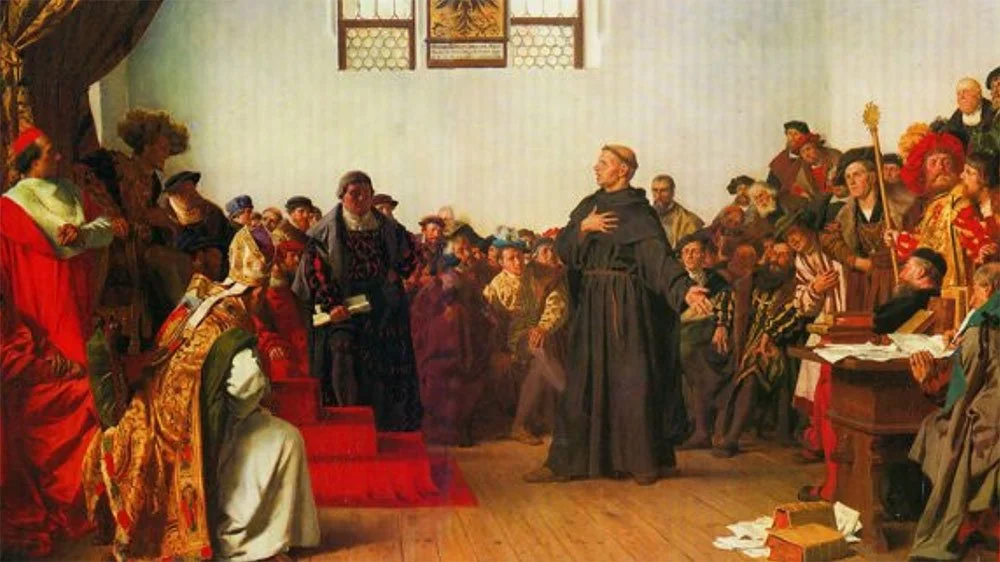
Martin Luther
Each CREC church must also adhere to one of seven (or ten or more, depending on reference sources) “confessions.” These historic Protestant confessions or statements of credal faith date to the Reformation Era – beginning with Martin Luther’s October 31, 1517 posting of his “Ninety-five Theses” on the door of Wittenberg Castle Church and running through either the 1555 Peace of Augsburg, which allowed Lutheranism and Catholicism to coexist in Germany, or the 1648 Treaty of Westphalia, which established the final religious boundaries of Europe. (FYI: The Castle Church door served as a university bulletin board; it’s unlikely Luther “posted” or “nailed” his Theses; he probably pasted them.)
“Confessions” summarize the churches’ interpretations of biblical doctrine and, while they serve as quasi-official records of what the individual church believes, in Reformed Protestant churches, they are subordinate to the Bible itself. This subservience to the Bible is reflected in the emphasis on Sola scriptura – the claim that the Bible (“Scriptura”) alone (“Sola”) is the exclusive and infallible expression of God’s will and the direction for salvation.
For CREC, acceptable confessions include:
Westminster Confession of Faith (1647)
American Westminster Confession of Faith (1788)
The Belgic Confession (1561)
Heidelberg Catechism (1563)
London Baptist Confession of Faith (1689)
Savoy Declaration (1658)
Reformed Evangelical Confession – a modern selection of the 17th century Westminster Shorter Catechism
Second Helvetic Confession (1536)
39 Articles of Religion (1571) – The foundational doctrinal statements of the Church of England and Anglican Communion were designed to outline a “via media” (“middle way”) between Roman Catholicism and Protestantism. Once binding under Henry VIII, Elizabeth I and their successors, they are now viewed more as an historic document. However,
Article 37: “The Bishop of Rome hath no jurisdiction in this Realm of England.”
Article 25 recognizes Baptism and Communion as the only sacraments ordained by Christ.
Article 22 rejected the Roman Catholic doctrines of Purgatory, indulgences, veneration of images, and invocation of saints.

Martin Luther
Doctrinally, CREC churches are united in one thing: A rejection of the twenty-five session Roman Catholic Council of Trent – 1545 – 1563.
Lasting just days shy of eighteen years, through twenty-five sessions and three popes – Paul III, Julius III and Pius IV, the Council was called to address real problems within the Roman Church: Popes and cardinals had become too worldly; bribery to gain church office was widespread; monasteries had lost their discipline; and the selling of indulgences was widely abused.
Happily, the Council abolished indulgence sellers and halted some of the worst abuses in the Church. It called for clergy members to avoid “even the smallest faults” including cardinals and bishops offering favors to relatives and having mistresses.
It also affirmed that there are seven sacraments – not the two claimed by Protestants – and that these are necessary for salvation. The Council re-affirmed transubstantiation – the Roman Catholic belief that the bread and wine consecrated in Mass become in substance the body and blood of Christ - and upheld the Latin Mass – in opposition to Protestant worship in the vernacular (language of the people). The Council asserted that no person can know for certain that he or she is justified/saved by faith alone and declared that good works contribute to right standing with God.
The Council split radically from Protestant reformers with its insistence that the only official version of the Bible was the Latin Vulgate and that personal interpretations could not depart from the Church’s teaching. Significantly (for Douglas et al) [We just had to throw in a little Latin.], Trent rejected the Protestant/Reformer position that “Scripture alone” – sola scriptura – was the exclusive source of theological authority. The Council asserted that Sacred Scripture cannot be the sole foundation of Faith. The Council declared authoritative theology is based on Scripture, Tradition and the Magisterium (derived from the Latin magister – “master”) – the pope and the bishops of the Church teaching in union (ecumenical councils).
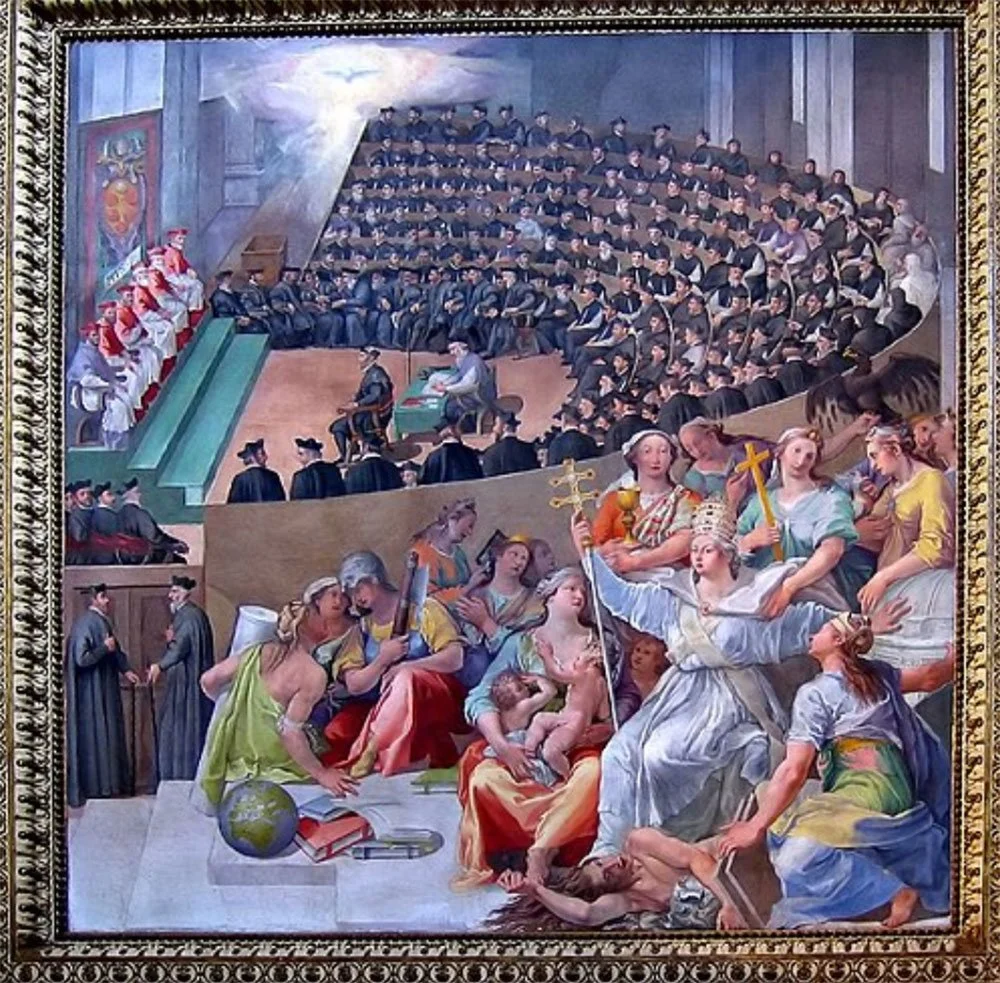
The Council of Trent
In an overly simplified explanation: Reformer Protestantism becomes a “one-legged stool,” standing on sola scriptura and the Council of Trent affirmed Roman Catholic theology as based on a “three-legged stool” – Scripture, Tradition and the Magisterium.
With its origins in the 1950s, Christian Reconstructionism - a theological and political movement within conservative Protestantism - argues society, as well as personal and public life, should be governed by biblical principles; it is the foundational basis of CREC and developed into a more organized movement in the 1960s.
HISTORY NOTE (Again):
The Reformation predates: the founding of New Jersey, the Carolina Colonies, Pennsylvania, and Georgia; the development of the rotary press (1843) and offset printing (1875); the Industrial Revolution (roughly 1760 to 1840); the Wright brothers first flight at Kitty Hawk on December 17, 1903; and the 19th Amendment to the U.S. Constitution granting women the franchise.
CREC accepts a wide range of Protestant Reformation creeds or confessions and CREC adherents are expected to reject the Council of Trent, all while seeming to work for a “christian nation” under the myth of the United States being founded as “a christian nation.” Nonetheless, there was no unity of faith among early Americans – it’s a fantasy.
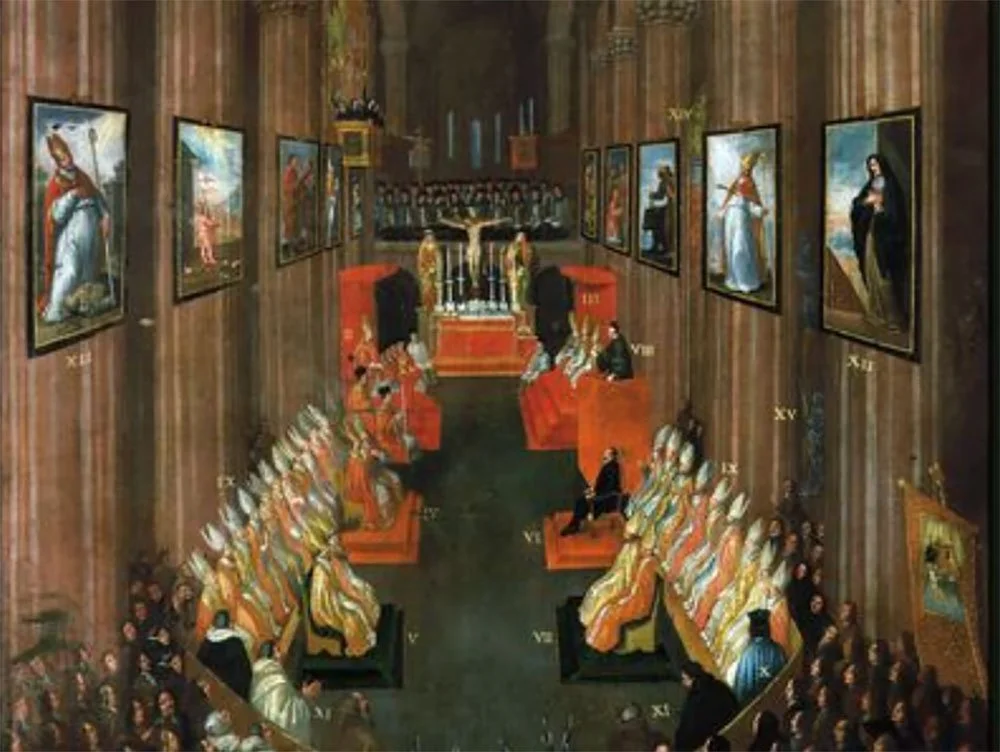
The Council of Trent
In his 2008 critically acclaimed New World Faiths: Religion in Colonial America, Yale University historian Jon Butler notes:
“By the Revolution, the middle colony congregations were divided among the Presbyterians, German Lutherans, German Reformed, Quakers, Dutch Reformed, Anglicans, Mennonites, Moravians, Catholics, German Baptists, and the newest and smallest of all the groups, English Methodists. At most, Presbyterians claimed 20 percent of the middle colony congregations, with the many additional denominations dividing the remaining 80 percent. By the time of the American Revolution, then, religious diversity had become one of the region’s most distinctive features and, in fact, a major component of colonial life everywhere.
“Three causes stimulated European religious pluralism in the American colonies after 1690: the immigration of Europeans from many different religious groups, the expansion of religious groups already present earlier but in only small numbers, and a surprising persistence of beliefs in magic and occultism long after the infamous Salem witch trials of 1692. These three causes together produced a religious diversity unmatched in any Old World society.”
It’s simple. By the December 16, 1773 Boston Tea Party, the future United States was home to a wide range of Christian denominations, believers in European magic traditions, alchemy and spiritualism, and German Pietism; Deism – an 18th-century rationalist belief in a creator God who does not involve himself in the world that was shared by Thomas Jefferson, Benjamin Franklin, Thomas Paine, and Ethan Allen; and Theistic rationalism – a middle ground balancing Christian traditions with rationalist, deistic ideas that was the approach of George Washington, John Adams and James Madison.
Please! Time to drop the “founded as a christian nation” stuff.
Let’s be honest and historically accurate!

The Guttenberg Bible
So, besides the apparent denomination of the Secretary of Defense of the United States, what is CREC?
With somewhere between 18,000 and 23,000 members in approximately 160 “churches” across North America, Europe, Asia, and South America, it is a christian denomination founded in 1993 in Moscow, Idaho calling for the establishment of a theocratic – governed by (Old Testament) religious laws – and structured on christian patriarchy.
With a strong hierarchical control over its members, CREC doctrine is opposed to religious pluralism or political viewpoints that diverge from its theology. Described in its website (crechurches.org/story) as an offshoot of Presbyterianism, it is self-described as “committed to maintaining its Reformed faith, avoiding the pitfalls of cultural relevance and political compromise that destroys our doctrinal integrity.”
Speaking in a rapid-fire cadence, Wilson opened a November 7, 2022 “Blog&Mablog” post (“Tenured Historians of the Golden Calf”) with the declaration “Separation of God and state is, therefore, a not-so-subtle attempt to turn the state into your god.”
And CREC is built on a patriarchy it claims to reflect the life and times of Hebrew (Old Testament) scriptures.
Wilson has expressed his and his church’s approach to patriarchal sexual relations:
“In other words, however we try, the sexual act cannot be made into an egalitarian pleasuring party. A man penetrates, conquers, colonizes, plants. A woman receives, surrenders, accepts…True authority and true submission are therefore an erotic necessity.” (Douglas Wilson, Fidelity: How to Be a One-Woman Man, Canon Press, 2012, p. 80–81)
That sounds like the psychology or theology of former Indiana University basketball coach Bobby Knight: “I think that if rape is inevitable, relax and enjoy it.” Or Indian Congress leader from the state of Karnataka KR Ramesh Kumar: “There is a saying that when rape is inevitable, lie down and enjoy it."

Wilson’s patriarchy?
“Suppose for a moment that he [a husband] wants to really serve God in their marriage, and she [his wife] appears to be distinctly rebellious about changing any of her ways. What course should a man pursue?…he should require something very simple, i.e., that the dishes be done after every meal before anything else is done. The first time the dishes are not done, he must sit down with his wife immediately and gently remind her that this is something which has to be done. At no time may he lose his temper, badger her, call her names, etc. He must constantly remember and confess that she is not the problem, he is. By bringing this gently to her attention, he is not to be primarily pointing to her need to repent; rather, he is exhibiting the fruit of his repentance. He does this, without rancor and without an accusative spirit, until she complies or rebels. If she complies, he must move up one step, now requiring that another of her duties be done. If she continues to rebel after patient effort, he should at some point call the elders of the church and ask them for a pastoral visit.” (“Doug Wilson Says If Your Wife ‘Continues to Rebel’ by Not Doing the ‘Dishes,’ ‘Call the Elders’ for a ‘Pastoral Visit,’” dougwilsonsays.com. April 7, 2026)
Require… Gently remind… Her need to repent… Move up one step… Call the elders….
Wow!