
I Was Always An American In My Heart
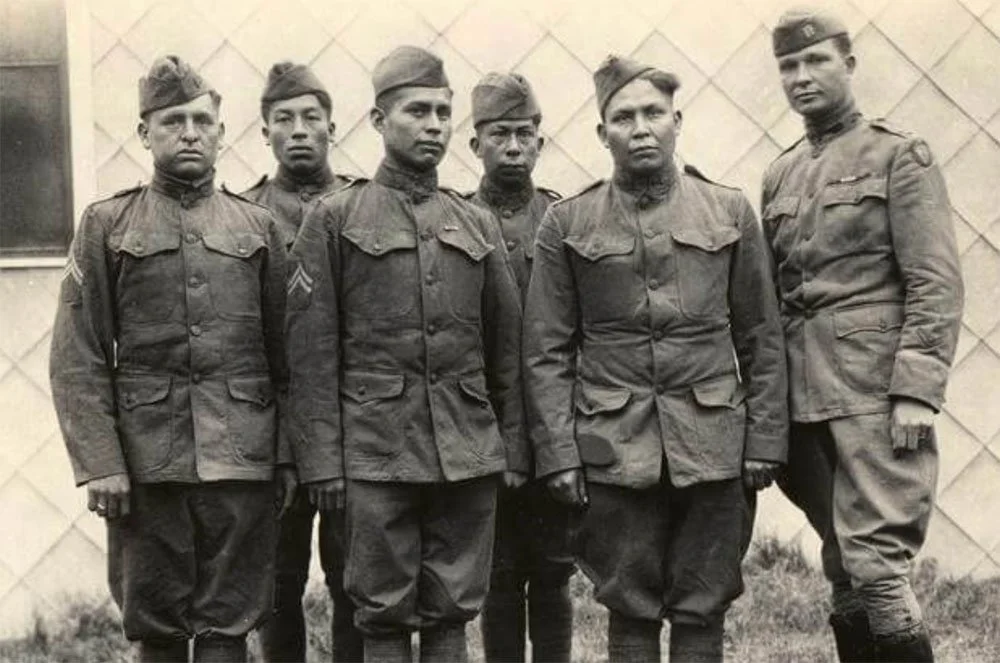
A squad of Choctaw Code Talkers in Camp Merritt, New Jersey.
At least in the beginning, this one’s just for fun.
Hopefully yours.
Certainly ours.
We can imagine the almost-bald head of the White House Deputy Chief of Staff for Policy and seemingly perpetually angry guy who stands so close to the president of the United States doing an involuntary imitation of Regan MacNeil’s (in)famous 360.
[EDITORS’ NOTE: For the too, too young to get that: In the 1973 flick The Exorcist, the possessed Regan, played by Linda Blair, turns her head a full 360 degrees during an exorcism.]
El peladito [The devil made us write that.] must be going bonkers that Texas – yes, Texas, the Lone Star State, the place that once belonged to Mexico – has honored a whole group of men who were not Americans. Well, not America in the sense that “baldy” would recognize, even though their ancestors were “Americans” before there was an “America.”
FIRST HISTORY AND BACKGROUND:
In 1879, Brig. Gen. Richard Pratt established the first Indian “boarding school” in the former barracks of an Army Cavalry school in Carlisle, Pennsylvania. Pratt explained:
“A great general has said that the only good Indian is a dead one … In a sense, I agree with the sentiment, but only in this: that all the Indian there is in the race should be dead. Kill the Indian in him and save the man.”
Operating in an essentially military fashion, the schools stripped students of every connection to their Native lives: Their tribal names and contact with family and other tribal members and hereditary religions; enforcing haircuts and uniforms and forbidding – and punishing – speaking their tribal languages.
W. Richard West, Jr., founding director of the National Museum of the American Indian, has cautioned:
“Language is central to cultural identity. It is the code containing the subtleties and secrets of cultural life. In many ways, language determines thought.”
On April 1, 2025, a new plaque was unveiled in Fort Worth’s Veterans Memorial Park. It honors 19 soldiers – not considered U.S. citizens at the time of their service to the United States – who were sworn to secrecy and, for decades, hid details of their military service from their families.
Not until 1989 did Nuchi Nashoba learn the secrets behind a black and white photo of her great-grandfather Ben Carterby inside her grandmother’s Oklahoma home. Over the past 20 years, Nashoba has led a dedicated advocacy, attempting to gain public recognition of the men who volunteered to fight for the U.S. in World War I at a time when those men were denied a citizenship for which they would not be eligible until almost six years after the war.
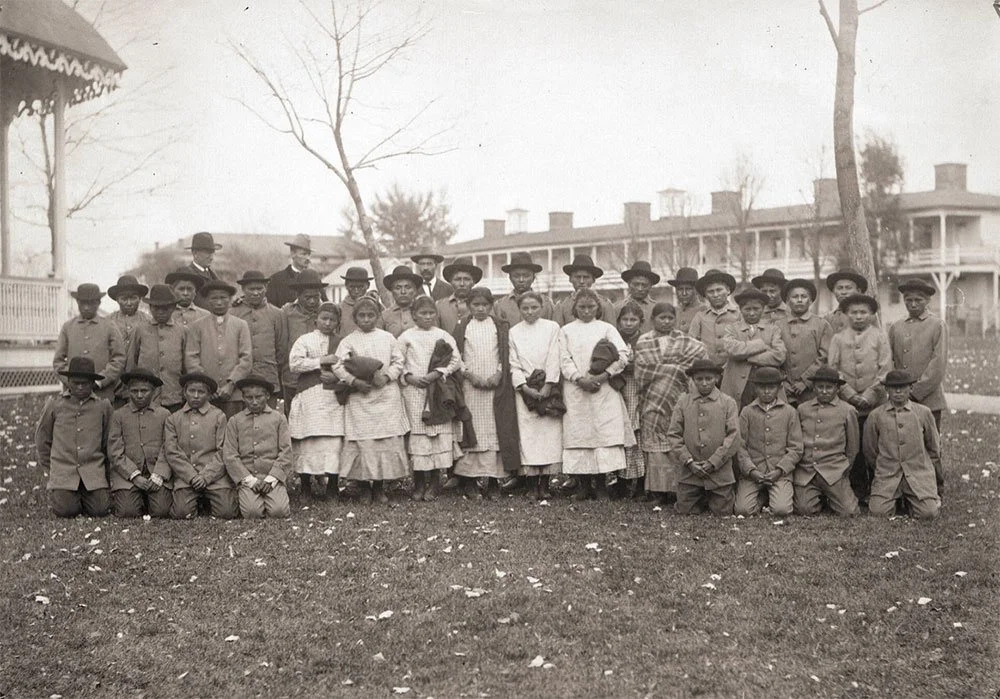
A group of Chiricahua Apache children who recently arrived at the Carlisle Indian Industrial School.
More than a century ago, 19 young Choctaw Native Americas volunteered, joined the U.S. Army and were among the 4.7 million-plus sent to the battlefields of Europe.
By late September 1918, the 30th Infantry Division realized that German forces had gained a battlefield advantage - they were able to tap into American Army phone lines and were regularly learning where U.S. and other Allied Forces were stationed and supplies kept. In the midst of a battlefield in France an American officer overheard some of the Choctaw Americans speaking in their “native language.”
Lightbulbs went off!
A brainstorm!
Choctaw Code Talkers – the “Choctaw Telephone Squad” - were eventually strategically positioned on front lines and at command posts so that messages could be transmitted; suddenly German telephone tappers could not understand this new “code.” Within 24 hours of utilizing the Choctaw language, Allied forces managed to turn the tide of the war by keeping communications confidential.
For the Choctaw Code Talkers, battalion became “twice big group,” “eight group” meant a squad,” casualties were “scalps,” tanamposhi hussatpalhi (“fast shooting gun”) was a machine gun, tanampo chito (“big gun”) referred to field artillery, and tyshka (“warrior”) – all in Choctaw dialogues between headquarters and the front lines.
Choctaw Nation Chief Gary Batton spoke to the complexity of the Code Talkers' service:
“It was a time when our people could not even vote; we were not even recognized as citizens. But our people stepped up for the greater good. To us, it wasn't a 'code' — it was our language and our culture being used to do the right thing for God and country."
German wire tappers were flummoxed and Allied messages could be transmitted without being understood by the enemy.
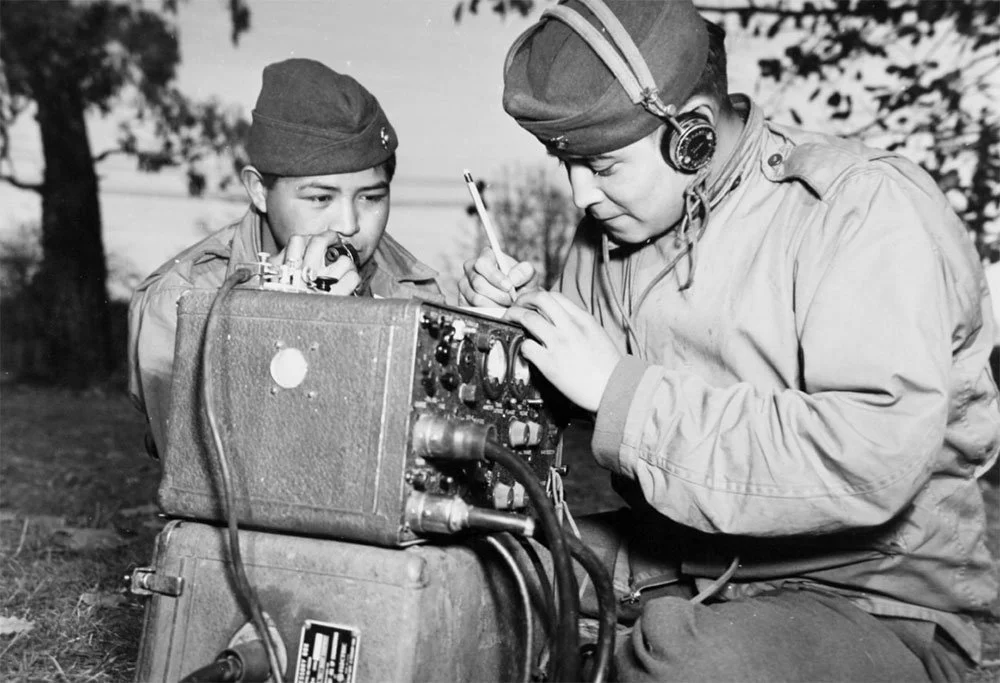
Navajo cousins Private First-Class Preston Toledo (left) and Private First-Class Frank Toledo were both Code Talkers. They served in a marine artillery regiment in the South Pacific.
Among the Choctaw Code Talkers were:
Victor Brown was one-fourth French and three-quarters Choctaw; he was proud of “fooling the Germans” with his Choctaw language and his service in France. He received a citation from President Woodrow Wilson after being wounded and gassed with mustard gassed in combat.
James Edwards was a member of the Choctaw language “relay team,” who helped work out the code words for critical information.
Otis Leader joined the Army when he was 34 years old and became one of the most totable heroes of the war. He had accompanied his Allen, Oklahoma Swiss employer on a cattle-buying trip to Fort Worth, when the employer’s Swiss accent and Allen’s tall, dark looks resulted in mistakenly pegging them as a German spy and his Spaniard employee. Infuriated by the misidentification (prejudice ???), Leader immediately went to the nearest recruitment office and signed up.
Bryan County was attending Armstrong Academy and lied about his age, pretending to be 18, so he could join his older friends.
Prior to the war, Walter Veach served in a unit of the National Guard on the border between the U.S. and Mexico; he and his unit were a major force in stopping Pancho Villa’s invasion of Texas.
Schlicht Billy was among the Allied troops 'in the landing at Anzio leading to the liberation of Rome and the invasion of southern France. He was a representative of the Code Talkers when the freed French government presented the Choctaw Nation the Chevalier de l’Order National du Merite.
During World War II, the United States Army developed a specific policy to recruit and train Native Americans as Code Talkers. Members of Choctaw and other Tribal Nations would also serve with distinction using Native languages in Korea and Vietnam
In the Pacific Theater of World War II, the Navajo used their traditional language to transmit Allied messages. In addition to all the training demanded of other Marines, the first class of 29 Navajo Code Talker Marine recruits had to develop and memorize a unique military code using their mostly unwritten language and were placed in a specially guarded room until this task was completed.
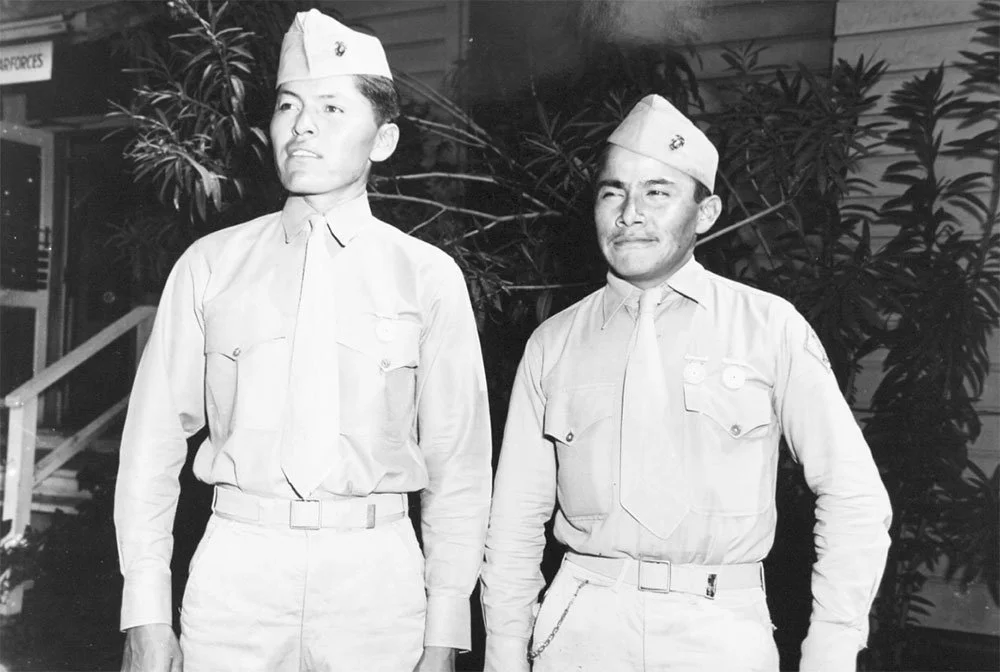
Navaho Code Talkers and U.S. Marine Privates First Class Alec E. Nez (left) and William D. Yazzie.
It was a two-fold task: First, the creation of a Type 1 code consisting of Navajo terms that stood for individual English letters to be used to spell out a word. Wo-la-chee – the Navajo word for “ant” - represented “a” in English, The Type 2 code contained words that could be directly translated from English into Navajo. Code Talkers developed a dictionary that eventually expanded from 211 to 411 military terms and names that did not originally exist in the Navajo language. For example, because there was no Navajo word for “submarine,” the term became besh-lo – “iron fish.”
During the War in the Pacific, Code Talkers were assigned in pairs – one person would operate a portable radio while the second would relay and receive messages in the Native language and translate them into English. Because Japanese forces deliberately targeted officers, medics and radiomen, the work of the Code Talkers was especially dangerous, and they had to keep moving as they transmitted their messages.
Native American Code Talkers played critical roles at Utah Beach during the D-Day invasion in France and at Iwo Jima in the Pacific. “Were it not for the Navajos, the Marines would never have taken Iwo Jima,” reported 5th Marine Division Signal Officer Major Howard Connor.
Because the codes they developed remained unbroken, the U.S. military wanted to keep the programs classified – in case Code Talkers were needed in future wars. As a result, Native American Code Talkers were told that they must keep their work secret. Like the Choctaw Code Talkers of World War I, the Code Talkers of the Second World War couldn’t even tell their families about their communications work.
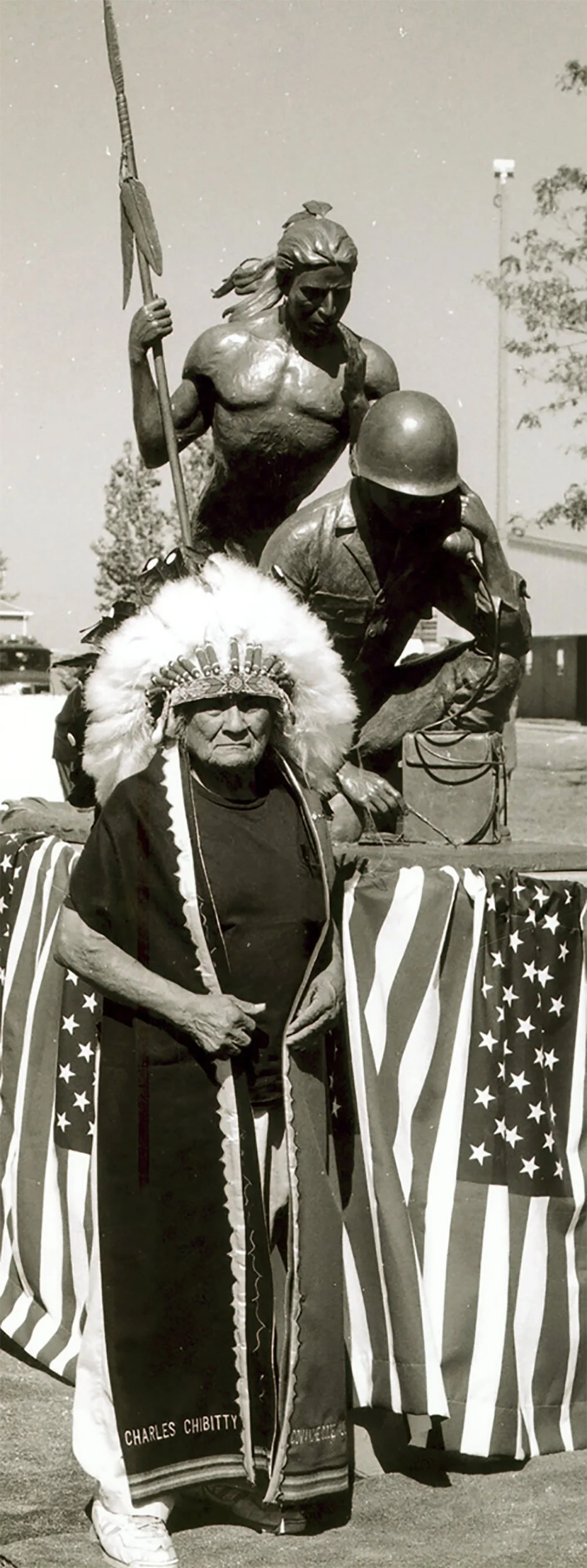
Comanche Code Talker Charles Chibitty attending the 2003 dedication of the Comanche Nation Memorial to the Comanche Code Talkers.
Thirty-three Native Americans have been awarded the Medal of Honor “For conspicuous gallantry and intrepidity at the risk of [their lives] above and beyond the call of duty.” Sixteen were honored before Native Americans were granted citizenship through the June 2, 1924 Indian Citizenship Act (the Snyder Act). While no Native Americans were honored for their service in World War I, the Medal was awarded to eight Native American veterans of World War II, five veterans of the Korean War, and three veterans of the Vietnam War.
Indigenous American communities were finally granted recognition as citizens in 1924, in no small part because of the fighting courage of Native American soldiers. However, it was not until the passage of the 1975 Indian Self-Determination and Education Assistance Act that Native nations were allowed to take responsibility for operating the programs and services traditionally run by the Department of the Interior. The 1978, American Indian Religious Freedom Act established a policy protecting and preserving the inherent rights of Native Americans (including Alaska Natives and Native Hawaiians) to believe, express, and exercise their traditional religions.
Significantly, the Code Talkers of World Wars I were not considered “American” and could not vote. In boarding and residential schools, they were punished for speaking the languages that saved “American lives” and contributed to winning two world wars.
The story of Native American Code Talkers, many of whom were not even considered “Americans” yet risked their lives to save “real Americans,” is especially important at a time when a presidential administration and el peladito are attempting to strip the rights and privileges of “real Americans” from so many who have given their lives to and for the United States.
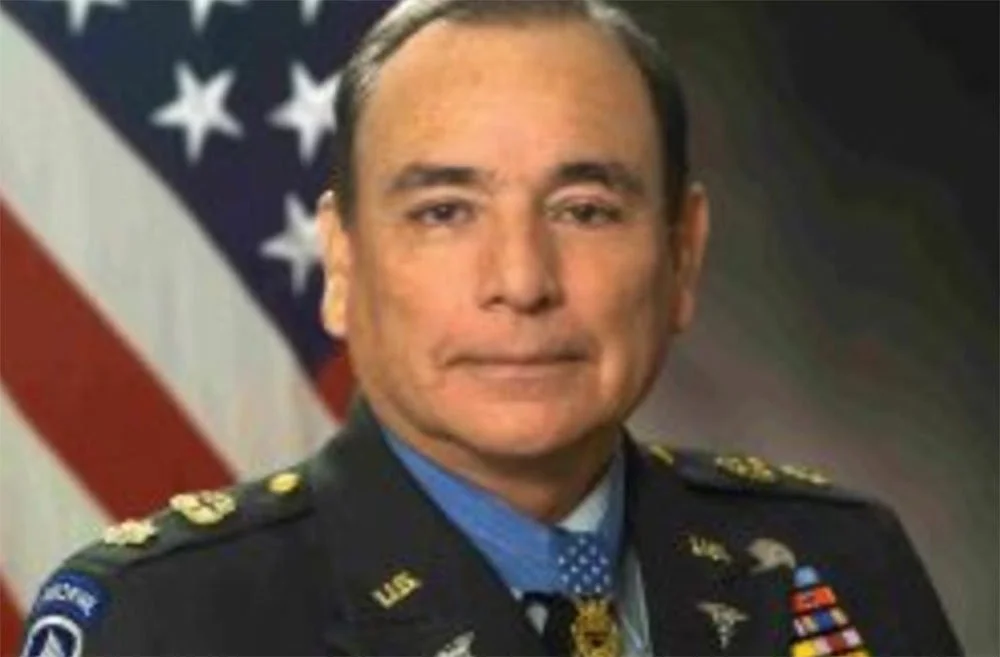
And just for good measure for El peladito:
United States Army Medic Alfred Rascon wasn’t “a real American” on March 16, 1966 when he ignored directions to stay sheltered until covering fire could be provided and, disregarding his personal safety and the bullets and grenades flying around him, placed his body between the enemy and a wounded soldier. That was only the beginning of his heroism that day. Ultimately, the already wounded Rascon covered the wounded soldier and absorbed the full force of a grenade explosion. After the enemy force broke and ran, Rascon disregarded is own wounds and repeatedly risked his life to provide care for other seriously wounded Americans.
Alfred Rascon was honorably discharged from active duty in May 1966 and entered the Army Reserve. He became a naturalized United States Citizen on March 13, 1967.
Although he was awarded a Silver Star Medal for his valor that day, the recommendation for a Medal of Honor was lost in a thicket of paperwork. Only when, during the 1985 reunion of his 173rd Airborne Brigade, his fellow soldiers discovered that he never received his intended award, were efforts renewed to honor his courage. President Bill Clinton presented the Medal of Honor to Rascon on February 8, 2000.
Mexican-born immigrant and Medal of Honor recipient Alfred Rascon was once asked about his courage on the battlefield fighting for America even though he had yet to become a citizen. “I was always an American in my heart,” said Rascon.
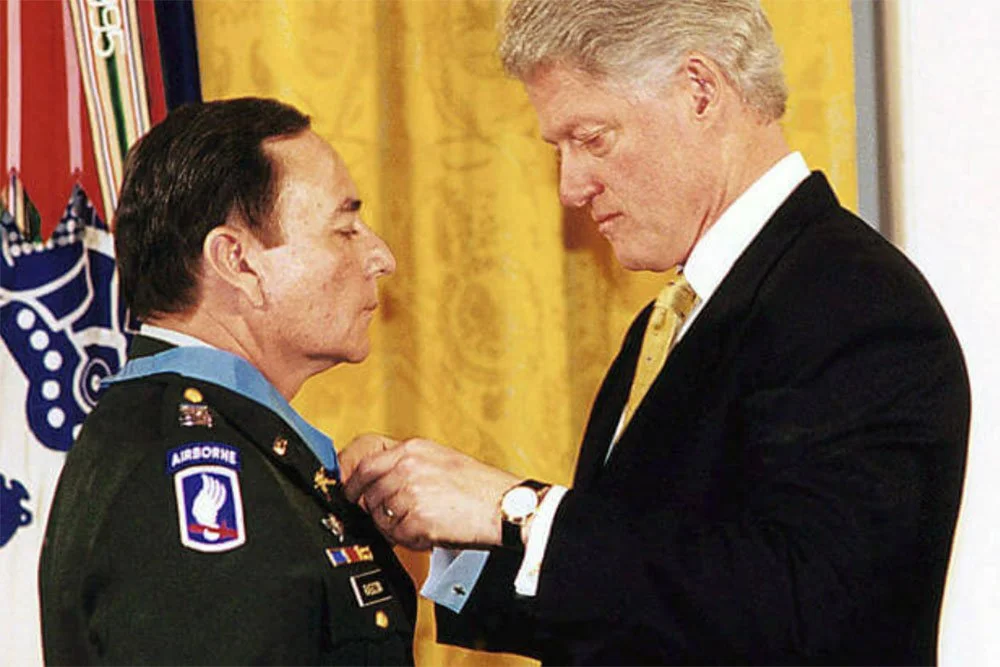
President Bill Clinton presented the Medal of Honor to Alfred Rascon on February 8, 2000.
We are seriously considering adding an intention to the “Prayer of the Faithful” (in the Roman Catholic Mass) and the “Prayers of the People” (in the Anglican/Episcopalian Mass):
“That el peladito and other members of the presidential administration will recognize the inherent and God-given goodness, patriotism and courage of those – our brothers and sisters – who live among us and are not yet citizens, of those who echo the words of Alfred Rascon: ‘I was always an American in my heart.’ We pray to the Lord. Lord, hear our prayer.”
In fact, we’re going to start including that in our private – in the secret recesses of our hearts – prayers.
We invite you to join us.