
No Nation Is Perfect
“Some of these soldiers fought and died
for a country that did not always
see them as equals”
The eighty-eight-day Schlacht im Hurtgenwald – the Battle of Hurtgen Forest – was the longest running World War II battle on German ground and the second longest battle U.S. Army history – days short of the three-month-long Battle of Bataan in the Philippines.
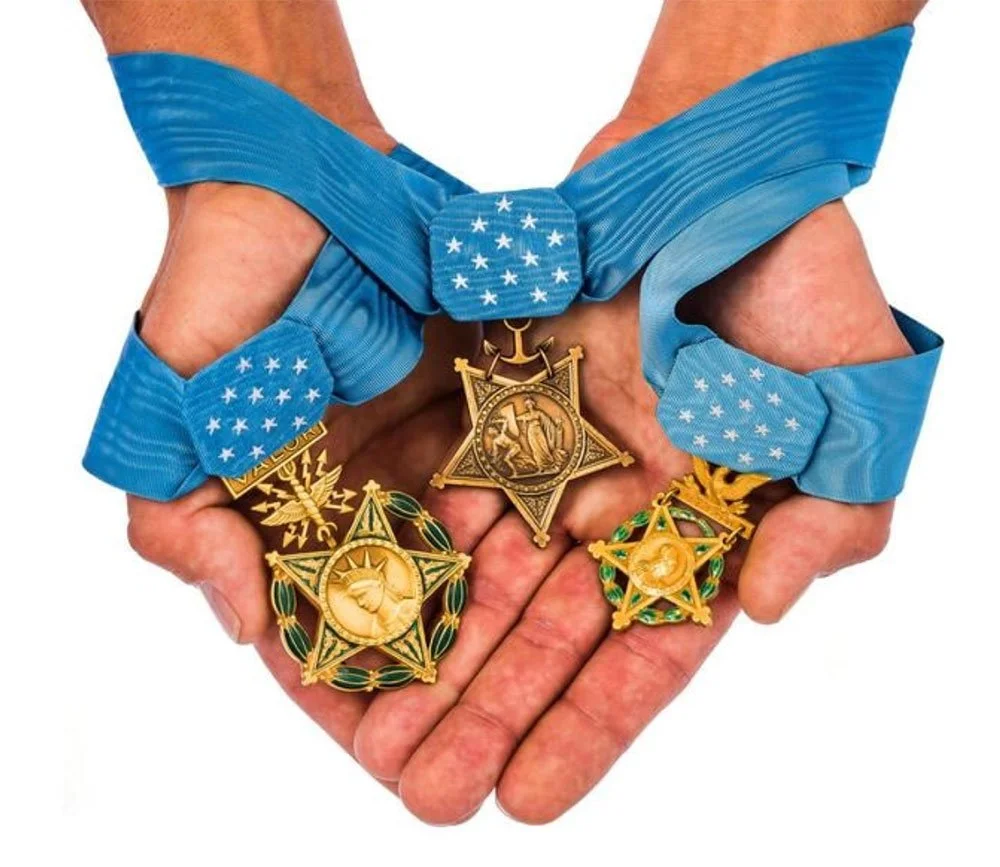
Seven men – Turney W. Leonard, Alfred B. Nietzel, Francis X. McGraw, George L. Mabry, John W. Minick, Marcario Garcia, and Pedro Cano – were eventually awarded the Medal of Honor “For conspicuous gallantry and intrepidity at the risk of [their lives] above and beyond the call of duty.”
At the time of the September 19 – December 16, 1944 contest, two of the recipients – Marcario Garcia and Pedro Cano - were not American citizens when they risked their lives to save their comrades in arms.
On November 27 and on his own initiative, platoon leader Marcario Garcia, recognizing that his team was pinned down by enemy fire, destroyed two enemy emplacements, captured four prisoners and, despite being wounded, continued to fight until the objective was taken. The citation of his Medal of Honor noted “Only then did he permit himself to be removed for medical care.” Several years later, he told The Houston Chronicle “I did not know the wound was so serious. I was numb, I think, and besides, we were moving forward, and it was not the time to stop.” Captain Tony Bizzaro, B company commander, recommended Garcia for the Medal of Honor and told The Chronical Garcia was nothing less than the best soldier in the Army – “He was always willing to do anything he was asked to do.”
President Harry Truman presented the Medal of Honor to Staff Sergeant Macario Garcia in a White House ceremony on August 23, 2945. Marcario became a citizen on June 25, 1947 – almost two years after receiving the nation’s highest honor for bravery and heroism.
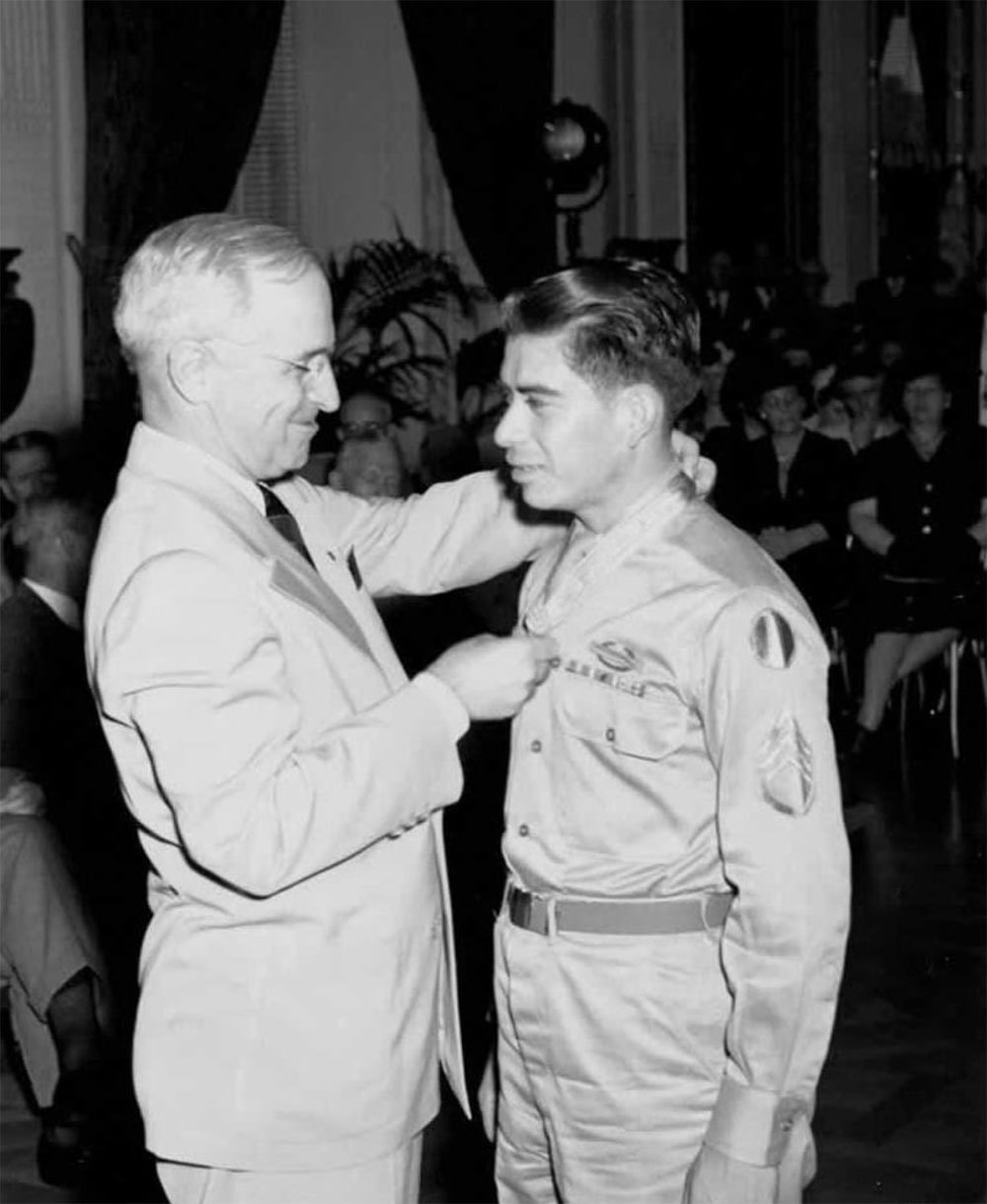
President Truman honoring Macario Garcia.
Pedro Cano was two months old when his family moved from La Morita Nuevo Leon, Mexico to Edinburg, Texas, where Pedro worked as a farm laborer until he volunteered for military service. He was awarded Two Bronze Star medals, a Purple Heart and a Distinguished Service Cross.
Cano’s heroic actions on December 3 were the stuff of a trilogy of hero movies. Nonetheless, he received his Distinguished Service Cross in the mail and, after showing it to some friends, put it away in a closet. Members of his American hometown community and local American Legion posts believed he deserved more – and better – and requested a formal military ceremony. Allan Enleman, publisher of The Edinburg Review, took up the cause, informing members of both houses of Congress of the hometown hero’s story. Ultimately, General Jonathan M. Wainwright awarded the Army’s second highest honor in a public ceremony and, after reading the accompanying citation with its account of Cano’s actions, noted that Cano deserved “a higher award [the Medal of Honor] but it is beyond my control.”
Texas State Senator Roger Kelly fought Cano’s cause, facilitating his naturalization in May 1946 and a grant of 40 acres of land and farm equipment; Cano returned to his prewar farming life.
With the exception of Texas state honors and the naming of a school and a street in his honor, Cano’s public story might have ended there.
But…
The 2002 Congressional Defense Authorization Act demanded a review of the World War II, Korean and Vietnam Wars records of Jewish American and Hispanic American veterans who deserved the Medal of Honor but were denied because of systemic and “leadership” prejudices.
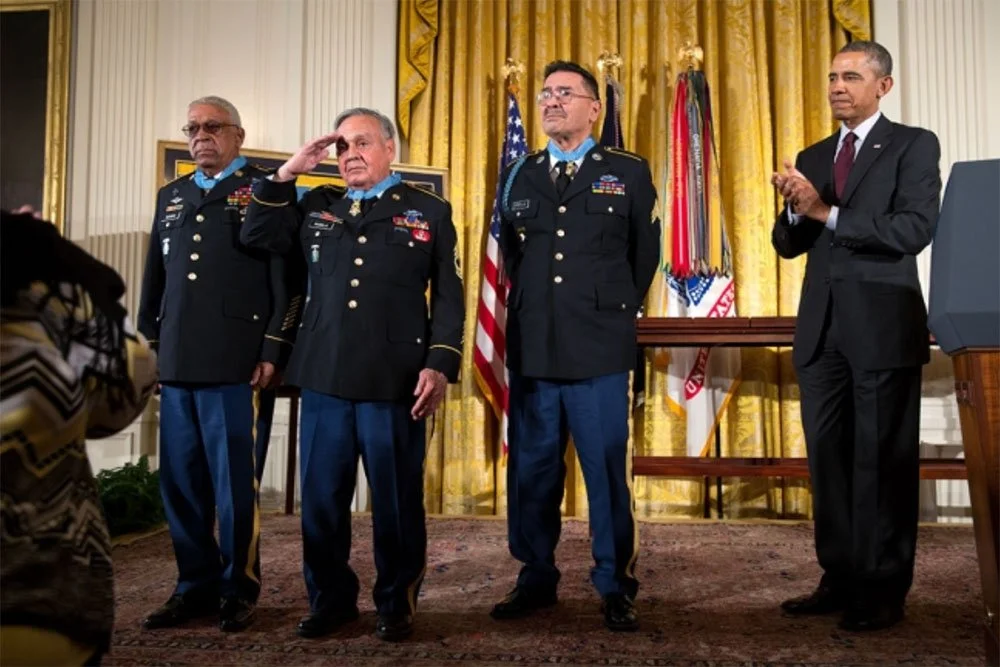
President Obama and Medal of Honor Recipients from left, Staff Sergeant Melvin Morris, Sergeant First Class Jose Rodela, and Specialist Four Santiago J. Erevia,
After a congressionally mandated 12-year Pentagon review, in May 2013, President Barack Obama personally called Pedro Cano’s family to inform them that he would posthumously receive the nation’s highest honor. During the March 18, 2014 ceremony, President Obama said:
“No nation is perfect. But here in America we confront our imperfections and face a sometimes painful past, including the truth that some of these soldiers fought and died for a country that did not always see them as equal. So, with each generation, we keep striving to live up to our ideals of freedom and equality and to recognize the dignity and patriotism of every person,"
Twenty-four Medals were presented that day. Three living veterans were honor; the Medal was posthumously awarded to seven World War II veterans, nine Korean War veterans and five Vietnam War veterans. All had been targets of their military leaderships’ anti-Hispanic and anti-Semitic prejudice.
[EDITORS’ NOTE: We recognize that after their deployments and upon returning to the States some (comparably speaking, a small handful) noncitizen veterans have committed horrible crimes and should be incarcerated. That’s simple. At the same time, many suffered “shell shock”/PTSD; others developed addictions while on active duty and in combat or as a result of what they experienced. (The term Post Traumatic Stress Disorder did not enter the psychiatric lexicon until the 1980 publication of the American Psychiatric Association’s Diagnostic and Statistical Manual of Mental Disorders 3). They wore the American flag on their uniforms; they fought for the American people. They deserve to be treated with honor, dignity and as Americans. There is no dignity for the Nation in deporting those who have served.]
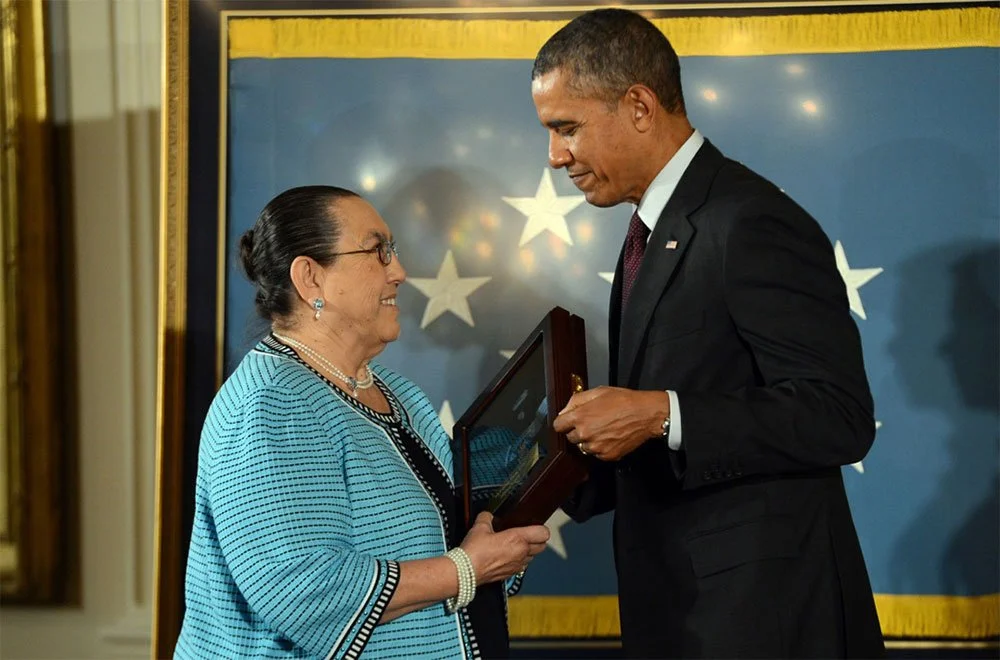
Dominga Perez accepts the Medal of Honor on behalf of her late father, Army Pvt. Pedro Cano
Consider…
“The Trump administration began deportation proceedings for 34 former members of the military over the past year, according to federal data obtained by The New York Times, after immigration authorities were directed to ignore previous guidance that gave service members and their relatives more deference.
“The 34 are among 125 former service members who were arrested over immigration violations over the past year, according to the data. Officials also placed 248 relatives of former military members into deportation proceedings.”
(“34 Former Military Members Were Put on Deportation Track in the Past Year,” Eileen Sulivan. The New York Times, May 24, 2026.
Having overstayed his foreign exchange student visa, New Zealander Paul Canton accepted the word of a recruiter that, if he served and was honorably discharged, he would receive citizenship. He served for seven years and, after discharge, built a life and family in Florida, where he voted seven times. Only after he applied for a new driver’s license did he learn that he had never really received citizenship. Despite the interventions of Florida politicians and Secretary of State Marco Rubio, “My oldest boy is going to empty out the house and sell it. And that’s the end of my time in America. Because I can’t come back. I have earned the title United States Marine and they’re never going to take that from me,” he told Military Times (“Florida Marine Veteran to Leave US After Long Citizenship Battle,” March 15, 2026)
“At a 2021 symposium on deported veterans presented by the University of Southern California and the Center for Law and Military Policy, one of the speakers, attorney Margaret Stock, said that recruiters often tell noncitizens they will become citizens if they take the military oath. Citing a 2022 personal account of a deported veteran, the Berkeley students agree, stating that military recruiters lie to immigrant enlistees by falsely asserting that military service automatically confers citizenship.
“In one instance, a citizen of Kenya, who served in both the U.S. Army and U.S. Air Force, was promised military enlistment would make him eligible for naturalization and veteran benefits. But the recruiter did not inform him that his student visa made him ineligible to enlist. After several years of military service, his student visa status was discovered and he was deported.” (Daily Journal/Cal Law, “Broken Promises: Deported veterans struggle to access entitle benefits,” April 2, 2024. Eileen C. Moore, Associate Justice, California Court of Appeal)
[EDITORS’ NOTE: After completing this post, we spoke at length with a Marine who served for eight years and left the Corps with the rank of Captain. He noted that the numbers demands made on Marine recruiters was a significant factor in recruiters making untrue statements to prospective Marines – including assurances of citizenship with enlistment. Recruiters’ careers and future promotions depend on meeting the numbers expectations and, in order to meet those numbers, recruiters may not be fully honest or may outright lie to noncitizen candidates about their naturalization.]
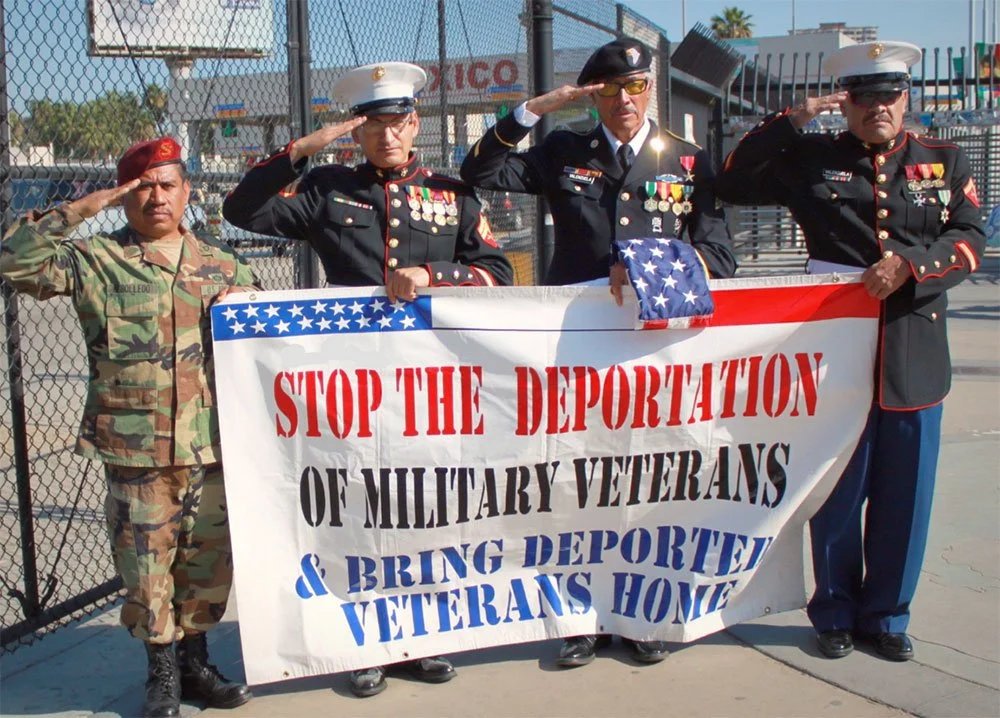
On December 15, 2017, Global Public Health: An International Journal for Research, Policy and Practice (“Deportation of non-citizen military veterans: a critical analysis of implications for the right to health,” Danielle Horyniak, Ietza Bojorquez, Richard F. Armenta, & Peter J. Davidson), noted three significant consequences for deported noncitizen veterans:
“First, honourably discharged deported veterans may be denied access to free or subsidised Veterans Affairs health services to which they would likely otherwise be entitled. Second, availability of and access to healthcare may be limited for reasons including barriers to enrolling in public insurance schemes, challenges navigating unfamiliar health systems and stigma and discrimination towards deported migrants. Finally, quality of available care may be sub-optimal due to limited expertise in service-related health issues and lack of evidence-based treatment for some health conditions (e.g. substance abuse/dependence).”
In the United States in 2022, an estimated 731,000 veterans were born in another county – roughly 4.5 percent of the nation’s 16.2 million veterans. That same year, only 10,690 military-based naturalizations were approved. To be eligible for naturalization through military service, a person must demonstrate “good moral character” for at least five years before applying. Due in part to PTSD, traumatic brain injuries or substance abuse, one-third of veterans report being arrested, compared to just one-fifth of non-veterans,
A message on the Web site of Immigrant Defenders Law Center reflects the reality of Marine Cantor:
“Immigrant service members who serve honorably in the U.S. military are legally eligible for expedited naturalization, yet this process is completed far less often than the law intends. Although hundreds of thousands of foreign-born veterans live in the United States, only a fraction have been naturalized. Many veterans are unaware that, without citizenship, they remain vulnerable to detention and deportation - even after risking their lives in service to the country. Because the government does not track how many veterans have been deported, the true number remains unknown.
“A significant number of deported veterans served in Vietnam, the Persian Gulf War, and the post9/11 war on terrorism, leaving many with serious physical and mental health needs. Deportation not only separates veterans from the nation and families they served - it also cuts them off from the Veterans’ Affairs (VA) medical care and benefits they earned through their service.”
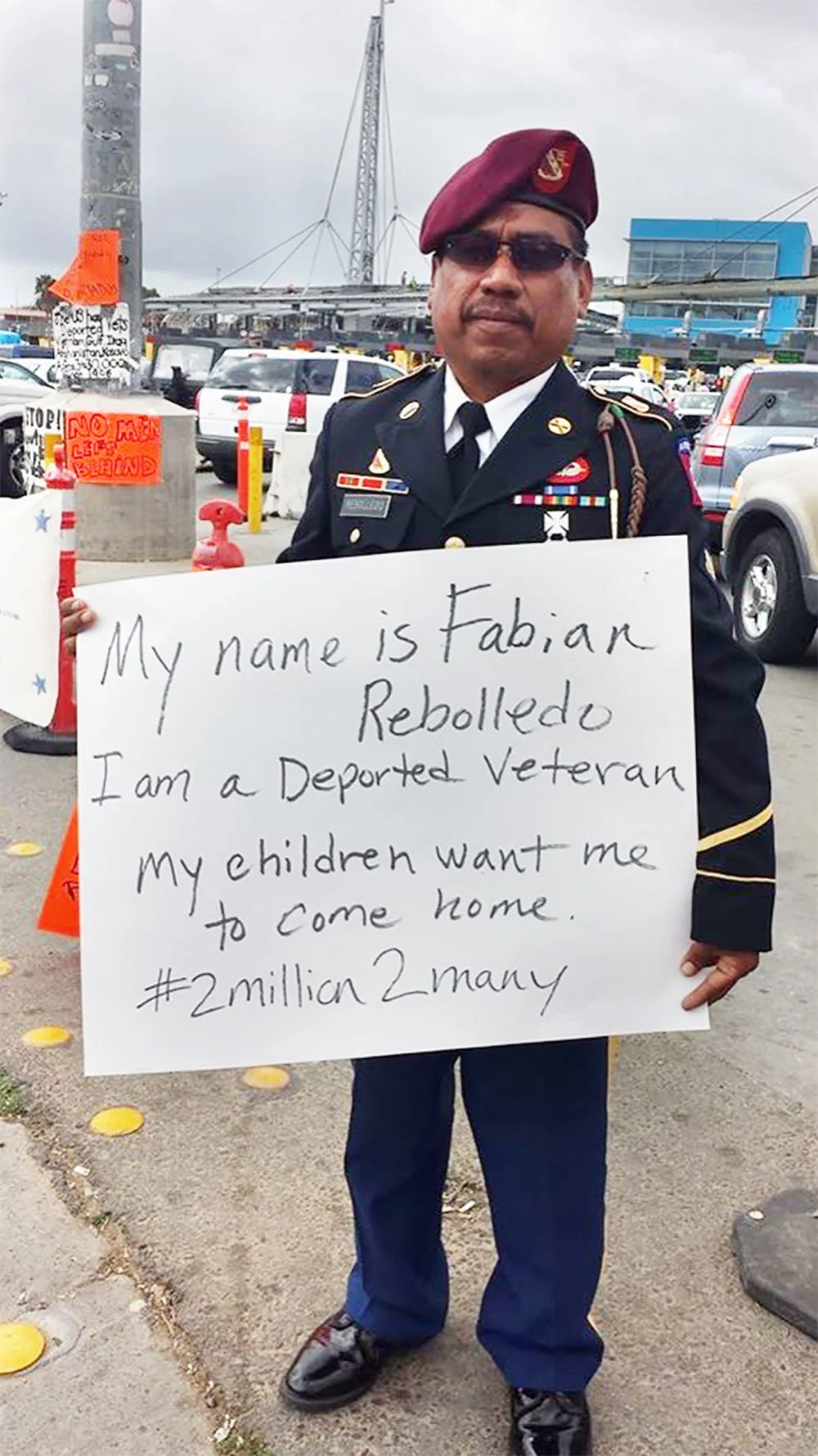
On June 24, 2025, ten members of Congress directed a letter to the Secretaries of Defense, Veterans Affairs and Homeland security noting their
“…profound concern regarding the deportation of veterans and servicemembers who have and are honorably serving in the United States Armed Forces. These individuals have demonstrated their commitment to our nation through their military service, and the prospect of their removal from the country they swore to defend raises serious questions about our nation's obligations and values.
“Some estimates state that the number of deported veterans is over 10,000 individuals or even higher…
“It is essential that our nation uphold its commitment to the men and women who have and are bravely serving in the armed forces. Understanding the challenges faced by non-citizen veterans in navigating our immigration system and the extent to which they are being deported is crucial for developing effective solutions and ensuring they receive the support and recognition they deserve….”
The Arizona Mirror, a self-described “…independent, nonprofit news organization that is focused on fearless journalism that shines a light on injustice and creates real-world change,” reported on November 20, 2025 (AZ Mirror, “Veterans condemn deportations of immigrant service members under Trump,” Gloria Rebecca Gomez.):
“In an effort to deliver on Trump’s mass deportation promise, immigration enforcement activity has surged, and noncitizen service members, who were previously afforded limited protections from detainment and removal, have been caught in the crosshairs.
“The deportation of veterans has been an ongoing issue, though a spotlight on an increase of removals by the Trump administration has prompted vocal criticism. In 2021, Biden issued an executive order that resulted in the creation of the Immigrant Military Members and Veterans Initiative, which worked to prioritize the return of deported veterans and their families.
“Signing up to join the military doesn’t require citizenship, just lawful permanent residency. During Joe Biden’s presidency, U.S. Immigration and Customs Enforcement agents were directed to take a military person’s record into consideration before arresting them. But under Trump, that guidance was replaced in April with a memo emphasizing that, while it would still be considered, military service alone doesn’t ‘automatically exempt aliens from the consequences of violating U.S. immigration laws.’
“It’s unclear how many foreign-born veterans have been deported since Trump took office. Some estimates project as many as 10,000 were expelled from the country between January and June, according to a letter sent to the U.S. Department of Homeland Security by Democratic members of Congress.
“At least two Iraq war veterans have been deported from Arizona. Marlon Parris, who was born in Trinidad but lived in the U.S. for more than 30 years, was arrested outside his Laveen home two days after Trump’s inauguration, despite previous assurances from ICE and the Department of Homeland Security that his nonviolent drug charge from 2011 wouldn’t result in his removal. He has since been deported to Mexico. And last week, José Barco, a Purple Heart recipient who was born in Venezuela to Cuban exiles, was deported to Mexico following 10 months in detention.”
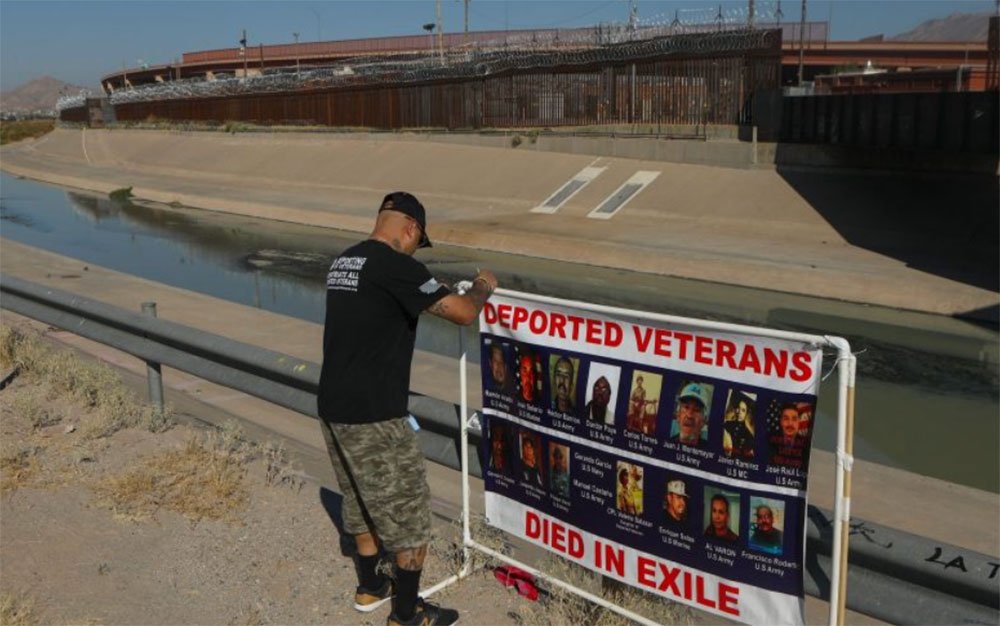
Ivan Ocon, a Mexican veteran of the U.S. Army deported to Mexico in 2016 after being assigned to guard the Iraqi border in Jordan during Operation Iraqi Freedom, ties a banner with pictures of deported veterans who died outside the U.S. in front of the border wall in Ciudad Juarez, Mexico, on Nov. 4, 2021.
Remember “Promises made. Promises kept”?
For noncitizen, foreign-born members and veterans of “the greatest military in history” too often it’s PROMISES MADE. PROMISES NOT KEPT.