

“Everything can be taken from a man but one thing:
the last of the human freedoms –
to choose one’s attitude in any given set of circumstances,
to choose one’s own way of life.”
Viktor E. Frankl
Sometimes… Perhaps more frequently than we’d like to admit, a poet’s most romantic images are just plain wrong.
In his 1890s “Mandalay” – later republished in Barrack-Room Ballads, and Other Verses, the English poet Rudyard Kipling declared “… the dawn comes up like thunder.”
We can overlook that the geography of Kipling’s piece just plain wrong, but there ain’t no way a new American dawn is going to “come up like thunder.”
So, we’re left asking “Now, what do we do? What do we say? Where do we go from here? How do we – as priests – share a message of hope?”
In our Anglican/Episcopalian and Roman Catholic traditions, Compline (“Night Prayers”) is the final prayer of the day – prayed in monasteries and convents and by priests, nuns and monks worldwide. The Compline prayers of Wednesday center around Psalm 130, among the briefest of 150 the psalms of Hebrew and Christian scriptures.

Out of the depths I cry to you, O Lord,
Lord, hear my voice!
O let your ears be attentive
to the voice of my pleading…
My soul is waiting for the Lord,
I count on his word.
My soul is longing for the Lord
more than the watchman for daybreak.
Let the watchman count on daybreak
and his people on the Lord.
Theologians note that Psalm 130 is one of the fifteen (Psalms 120 – 134) “Songs of Ascent,” sung by ancient travelers going up from their homes to the Temple in Jerusalem for the three Pilgrimage Festivals - Passover, the Feast of Weeks (Shavuot), and the Feast of Tabernacles (Sukkot). It is easy to imagine disparate village groups meeting on their journey up to the City of God, their voices blending as they sang together.
It is also a “Lamentation Psalm” – addressing God in the midst of personal distress and begging Him to forgive the petitioner’s “iniquities” - wrong-doings. “Iniquities” (‘avonoth) is found more than 200 times in the Old testament and is based on a root meaning “to bend, curve, turn aside, or twist,” giving us a sense that, because God provides forgiveness, he is to “be revered.”
[EDITORS’ NOTE: One of us has always had a difficult time with scriptural references to the “fear of God” or “fearing” as a part of our relationship with God. (We’ll let individual readers decide which one.) Nonetheless, we recognize that the Hebrew root yirah has a much more expansive meaning: “awe, reverent respect, honor,” as synonyms for “love” (ahab, Deuteronomy 10:12); “cling to” (dabaq, Deuteronomy 10:20); and “serve” (‘abad, Deuteronomy 6:13).]

In Psalm 130, “The watchman counts on daybreak” because he looks back in order to look forward. He has stood through the darkest of nights and, time and again, night has been followed by the quiet slipping-in of dawn. Not “like thunder,” but in tiny, almost imperceptible wisps of light – far off in the seemingly eternal dark.
The watchman counts on daybreak because he looks back and remembers.
The watchman looks back and counts on the coming of tomorrow.
The watchman looks back – to all the daybreaks that have followed the darkest of nights – and so can look forward to the tiny, almost imperceptible first glint of the coming dawn.
That is our priestly (hopefully, prophetic) message to the Nation: Let us look back in order to look forward; only by looking back can we anticipate a dawn that will enable us to move beyond the rancor of recent years.
+++++
The dawn….
In the summer of 1926, Benjamin Davis, Jr. was thirteen years old when his father arranged for him to fly with a barnstormer at Washington, D.C.’s Boiling Field. His immediate reaction: “I want to be a pilot.” [In the post-World War I era, “Barnstormers” were “flying circus” acrobats who moved from town to town and charged for back seat rides with grass field take-offs, loopty loops and other stunts.]
After attending the University of Chicago and sponsored by Chicago Republican Congressional Representative Oscar De Priest, at the time, the only Black member of Congress, in 1932 Benjamin Oliver Davis, Jr. entered the United States Military Academy at West point as the first Black cadet in more than forty years. Between its founding in 1802 and Davis Jr.’s admission, West Point had admitted eleven Black cadets; only three graduated.
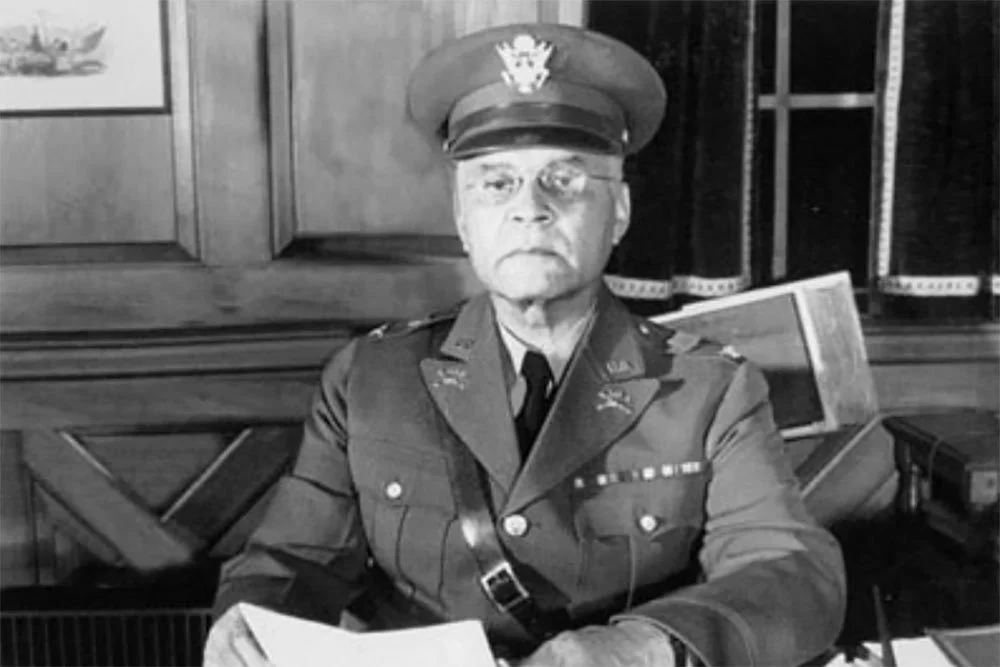
General Benjamin O. Davis, Sr.
Davis, Jr. was shunned; other cadets would only speak to him for official reasons; he ate alone and never had a roommate. He was forced to ride – as the only Black cadet – as on a separated bus with a white driver. Despite others’ determination to drive him from the Academy, he graduated thirty-fifth out of 276 in the Class of 1936. Incongruously, below his picture in the Academy’s 1936 The Howitzer yearbook is the description
"The courage, tenacity, and intelligence with which he conquered a problem incomparably more difficult than plebe year won for him the sincere admiration of his classmates, and his single-minded determination to continue in his chosen career cannot fail to inspire respect wherever fortune may lead him."
At his graduation/commission as a Second Lieutenant, the United States had only two Black line officers – Benjamin O. Davis, Sr. and Benjamin O. Davis, Jr.
Despite being academically and physically qualified, the younger Davis was turned down for flight training because there were no Black units in the air service and, following Infantry School, he was assigned as a Reserve Officers Training Corps instructor at Alabama’s all-Black Tuskegee Institute, the nation’s first Black college. The Army’s way of avoiding having a Black officer in command of white soldiers, it was also a position Davis Sr. held decades earlier.
In 1941, while Davis was at Tuskegee, President Franklin Roosevelt ordered the War Department to create a Black flying unit. The Army Air Corps wanted a Black West Point graduate to command the new wing and Davis was the only living Black West Point graduate. He saw an opportunity to undermine segregation and he took it.
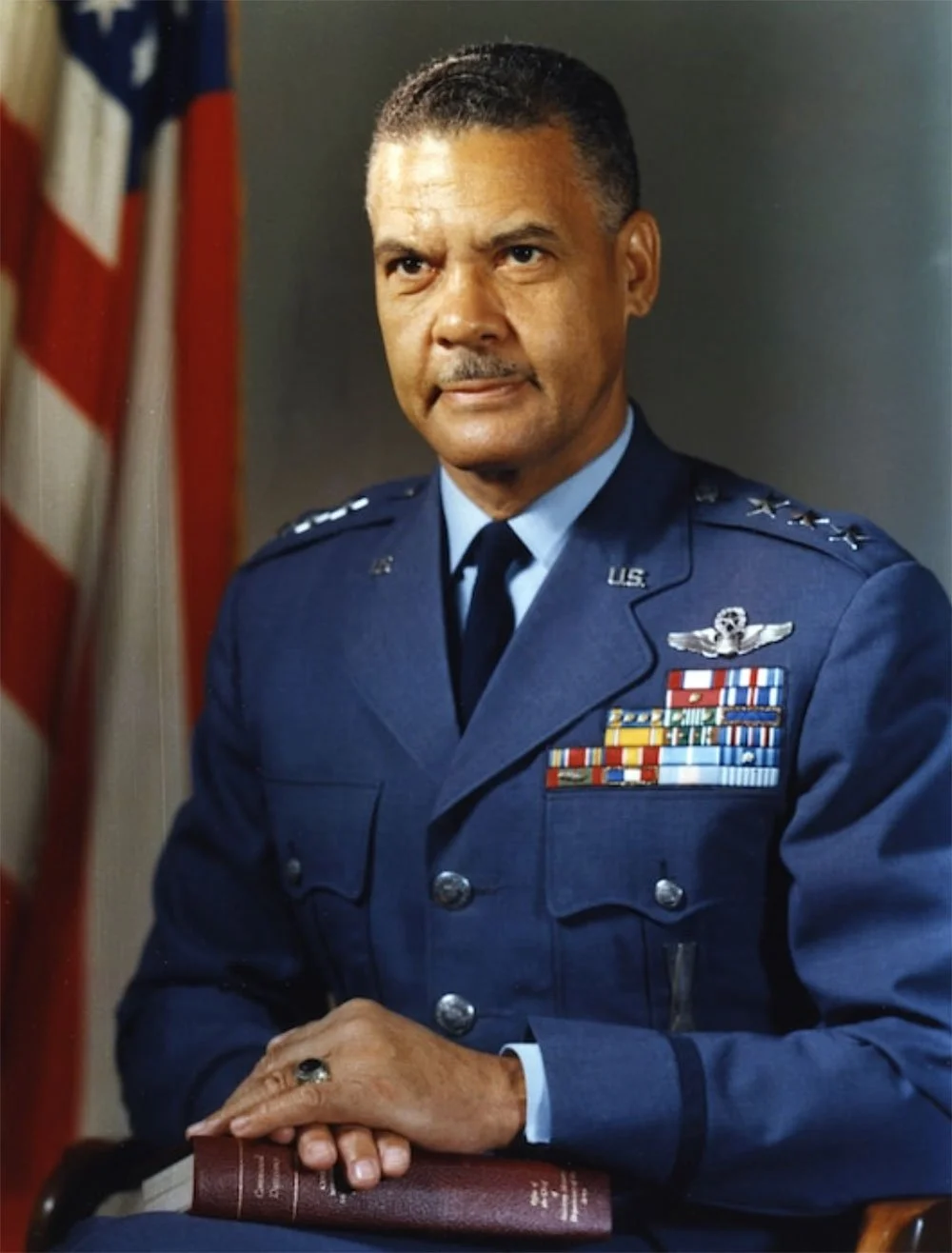
Gen. Benjamin O. Davis, Jr.
Before beginning flight training at Tuskegee Army Base, Davis famously declared “Sergeant, this is 1942, we're in a war, I have the skills, and I want to fly for my country.” He received his pilot’s wings in March 1942. One of five Black officers to complete the course and the first black officer to solo an Army Air Corps aircraft, he transferred to the Army Air Corps two months later. Following tours in Europe and North Africa, as well as bases in the U.S., he was named Deputy Chief of Staff for Operations at Headquarters for the US Air Force and completed advanced jet fighter gunnery school.
Rising through the ranks, Davis, Jr. was temporarily promoted to Brigadier General in 1954 and promoted through Major General and Lieutenant General; in 1998, President Bill Clinton pinned on his four-star insignia.
+++++
The first whispers of dawn…
Despite attending classes at the historically Black Howard University during his senior year of high school, it is likely that Benjamin O Davis, Sr. forged his birth certificate to enlist in 1898; he served as a first lieutenant during the final year of Spanish American War, but his regiment never saw action. After the war, he reenlisted as a private in the regular Army, joining the all-Black 9th Cavalry Regiment – the famed Buffalo Soldiers. Within two years, he passed the officer’s test and became a second lieutenant with the 10th Cavalry; he went on to serve as a professor of military science and tactics at Wilberforce College, as a military attaché in Liberia, and again with the Buffalo Soldiers – this time in the Philippines, where he was promoted to captain.
As a lieutenant colonel, BOD, Sr. served with the 99th Fighter Squadron, the first all-Black united in the Army Air Force in North Africa in 1943, before assuming command of the 332nd Fighter Group. His military career was too extensive to recount in this space.
So, let’s just skip to the critical moment:
In late 1940, with the nation on the verge of entering the war in Europe and facing reelection, President Franklin Roosevelt recognized the need for Black support. While civil rights leaders aggressively lobbied the White House for Black solders to be appointed to positions of leadership, military leadership pushed back. When DOB, Sr. was omitted from the promotion list, Roosevelt personally intervened, overriding Army leadership. On October 25, 1940, DOB, Sr. was officially promoted to Brigadier General – the first Black soldier to achieve the rank.

President Harry Truman officially integrated the military by Executive Order in 1948 and the following year the Air Force became the first branch of the military to integrate.
Despite the efforts of the (at the late-October writing of this post) present secretary of defense, the integration of the military services of the United States is as ingrained as the red, white and blue of the Flag. At best, the secretary and the administration to which he belongs will pass into history in just over two years.
As the nation – like the watchman of the psalm – awaits the reassuring promise of a new sun breaking over the horizon, let us take courage from the lives of a father who – a century ago – made it possible for his son to dream “I want to be a pilot,” to defy the shunning of West Points cadets, to insist “Sergeant, this is 1942, we're in a war, I have the skills, and I want to fly for my country,” and to become the first Black Four Star General of the United States Air Force.
As men and women of faith and no faith, let us learn the lesson of the watchmen, the lesson of Compline, the lesson of Psalm 130. Let us – together – dare to curse the darkness.
“…Maybe the practice for today is smaller than we thought.
Tell the truth.
Do the next loving thing.
Borrow hope from community when yours is thin.
Tell the truth because denial will not heal you.
Do the next loving thing
because love keeps you connected to what is real.
Borrow hope because there will be days
when someone else can believe
on your behalf until your own heart catches up.
That is not failure.
That is being human.
If your hope is quiet right now, let it be quiet.
If your faith feels more like a flicker than a fire,
do not despise the flicker.
If all you can do today is stay tender,
tell the truth, and take one faithful step, that is not nothing.
It may be the holiest thing you do today.
Still here.
Still trying.
Still soft enough to care.”
That counts.
Brandon Cox
“The Quiet Kind of Hope That Still Counts”

Let us be the first, the smallest glint that promises a new dawn.
Out of the depths I cry to you, O Lord,
Lord, hear my voice!
O let your ears be attentive
to the voice of my pleading…
My soul is waiting for the Lord,
I count on his word.
My soul is longing for the Lord
more than the watchman for daybreak.
Let the watchman count on daybreak
and his people on the Lord.