
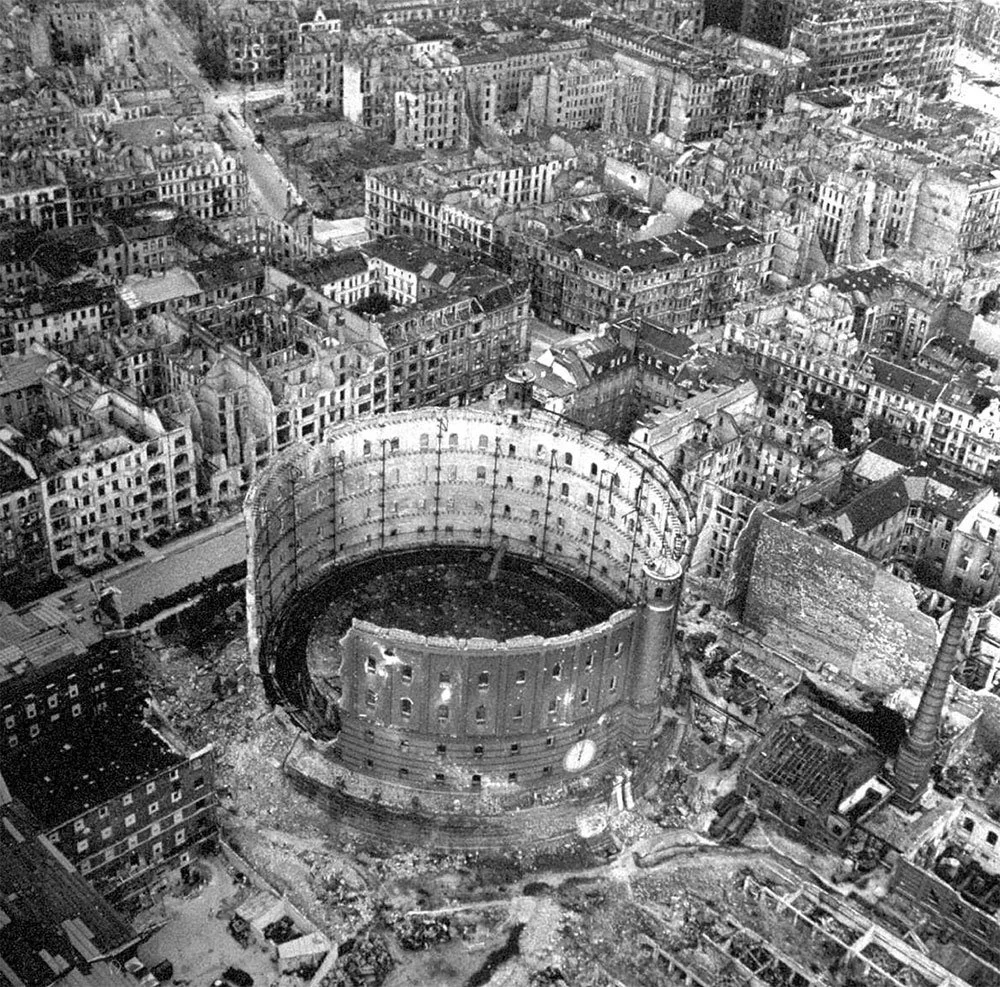
Bombed-out Berlin
"World peace cannot be safeguarded
without the making of creative efforts
proportionate to the dangers which threaten it."
Robert Shuman
"A politician looks to the next election.
A statesman looks to the next generation"
Alcide De Gasperi
AuthenticHealers is pleased to announce our post-elections “Why Were They Important? Contest.”
No Google or AI cheating allowed. (Remember! We work for the Guy Who Sends Lightning Bolts!)
THE QUESTION: Who were Robert Schuman and Alcide De Gasperi and why were they important.
CLUE: Pope Leo XIV cited them in his address in Metz on Monday, September 28 - the last day of his pastoral visit to France.
“Today, sadly, war has returned, even to Europe: a new ‘senseless slaughter,’ claiming countless civilian lives every day. We need to commit ourselves to patient dialogue, to show courage in negotiation and to be willing to give up some positions for the greater good of peace,” Pope Leo XIV told European leaders on September 28 at the Robert Schuman Conference Center in Metz
AuthenticHealers chose to highlight Pope Leo’s words, the setting and Shuman and De Gasperi because they serve as guidelines for every member of the approaching 127th Congress. Significantly, as he made that statement, Leo was accompanied by France’s Chief Rabbi Haïm Korsia, Chems-eddine Hafiz of the Grand Mosque of Paris, Protestant Federation president Christian Krieger, Greek Orthodox Metropolitan Dimitrios and Anthony Boussemart, representing France’s Buddhists.
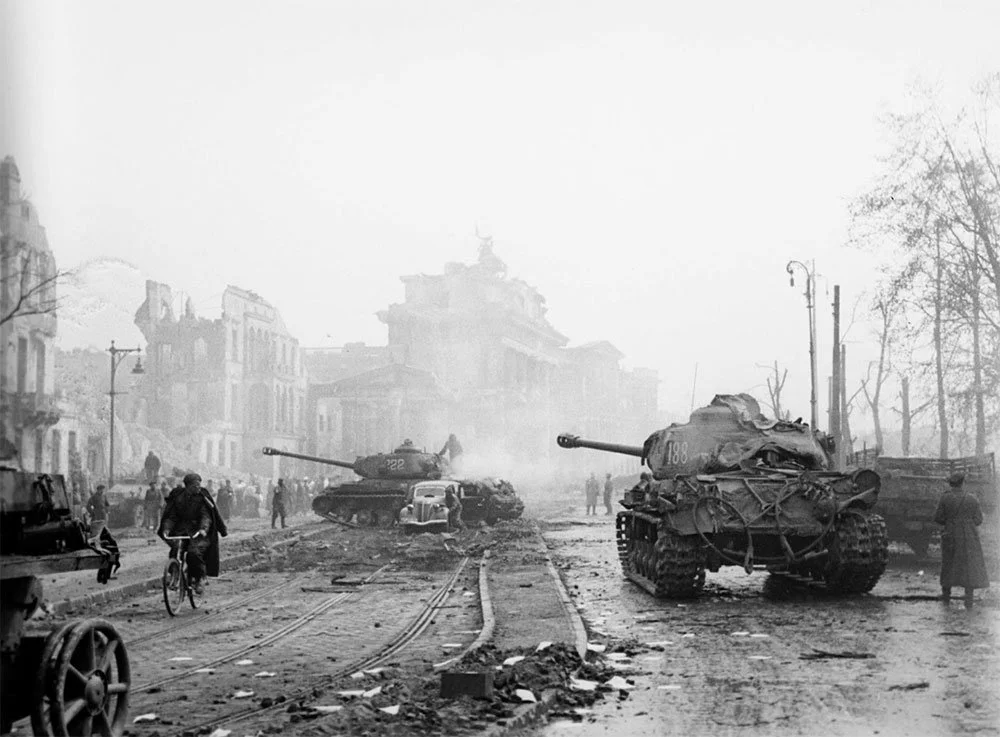
Tanks in the streets of Berlin
More importantly, he deliberately turned to these religious leaders and addressed them directly:
“Indeed, to invoke God’s name in order to justify violence or oppression is to profane that name. Nothing that disfigures human dignity can claim to be inspired by God. Religious discourse must constantly call for the disarmament of hearts and words.”
Pope Leo concluded by noting that the Church regards all who sincerely seek “truth, goodness and beauty” as companions on the journey.
The road leading to their papal recognition began well before their births – Shuman (1886) and Alcide De Gasperi (1881). Explaining the prelude to their diplomatic efforts is analogous to mastering Mandarin Chinese overnight.
Following Prussia’s decisive 1866 victory over Austria, Chancelor Otto von Bismark attempted to assert a dominant position in continental Europe by persuading the independent southern German states of Baden, Wurttemberg, Bavaria, and Hess Darmstadt to join the North German Confederation in a powerful new alliance on France’s eastern border. A move France couldn’t and wouldn’t ignore. Bismark saw war with France as an opportunity to unify all of ethnically German Europe: “I knew that a Franco-Prussian war must take place before a united German was formed.”
When Leopold, Prince of Hohenzollern, appeared as the primary candidate to assume the newly vacant throne of Spain – a positioned he rejected but a situation that would have left Spain surrounded, Bismark engaged in some diplomatic sleight-of-hand (forgery) and provoked France into declaring war.
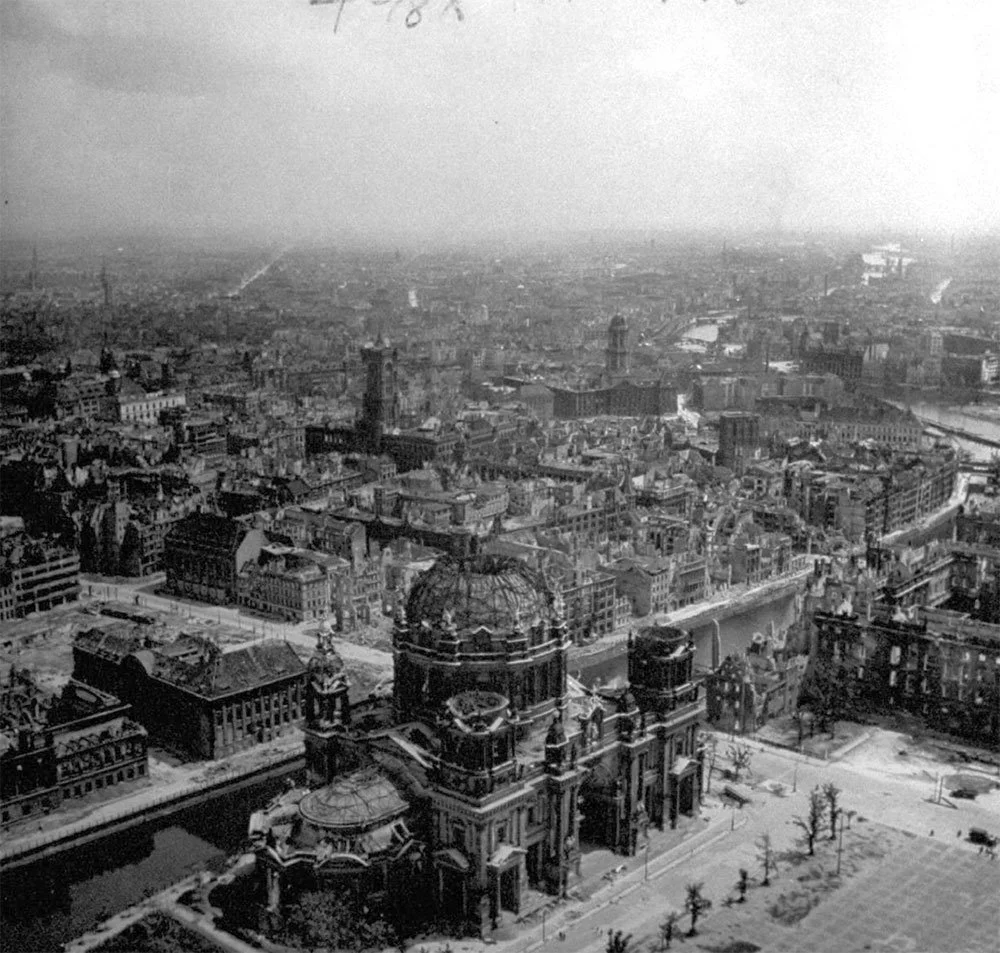
For every inhabitant of Berlin there were nearly 30 cubic meters of rubble.
The ensuing and brief – July 19, 1870 – January 28, 1871 (193 days) – war was centered in eastern France with the cities of Alsace, Lorraine and Metz bearing the brunt of the conflict; the Battle of Sedan (September 1-2) was marked by the capture of Napoleon III, the fall of the Second French Empire and Europe thrown into a seemingly endless series of conflicts over which major powers – France or Germany – had control over what territories. The war cost 77,000 to 88,000 French soldiers killed or wounded, 45,000 to 51,000 deaths from smallpox and other diseases, and 104,000 French soldiers taken prisoner; German casualties included 50,000 killed or wounded.
In the simplest terms, the Europe of the second half of the Nineteenth Century was not the Europe of 2026. The Kingdom of Italy under Victor Emmanuel II was only declared a unified country on Mar 17, 1861, but Venice was officially annexed after the Third Italian War of Independence and Rome was liberated from the French in 1870 – because the French were too occupied fighting the Prussians.
The May 10, 1870 Treaty of Lorraine saw the establishment of a newly unified German state on a European stage that had previously been dominated by the great empires of England and France, forced France to cede Alsace and parts of Lorraine to Germany and required France to pay a five billion francs indemnity to Germany. It marked the end of the Second Empire of France and saw the rise of the French Third Republic. Most importantly, from the German perspective, it established a Prussia free from French influence.
Unfortunately, it did not mark the end of armed conflicts in Europe.
The Russo-Turkish War (1877-1878) pitted the slowly contracting (dying) Turkish Ottoman Empire, spanning most of Southeastern Europe, West Asia and North Africa from the 14th century to the early 20th century, against non-Muslim (Christian) Russia and its (from the sidelines) European allies. (De facto, it was the tail end of a “war” that ran from 1468 to 1918, with the most important conflict in 1877-1878.) In its final stage, the Russian Coalition, including Romania, Serbia, Montenegro, and Bulgaria, sustained roughly 15,567 to 20,000 killed in action and 81,166 deaths from disease. The Ottoman Empire lost 90,000 to 120,000, largely as a result of intense fighting, the winter cold and rampant disease.
The Russo - Japanese War of 1904 to 1905 not only sparked the Russian revolution of 1905 but transformed Japan from an isolationist feudal state into a modern power, ready to assert itself against still dynastic China. Ultimately, the war emboldened militarists in the Japanese forces, setting the stage for later conflicts.
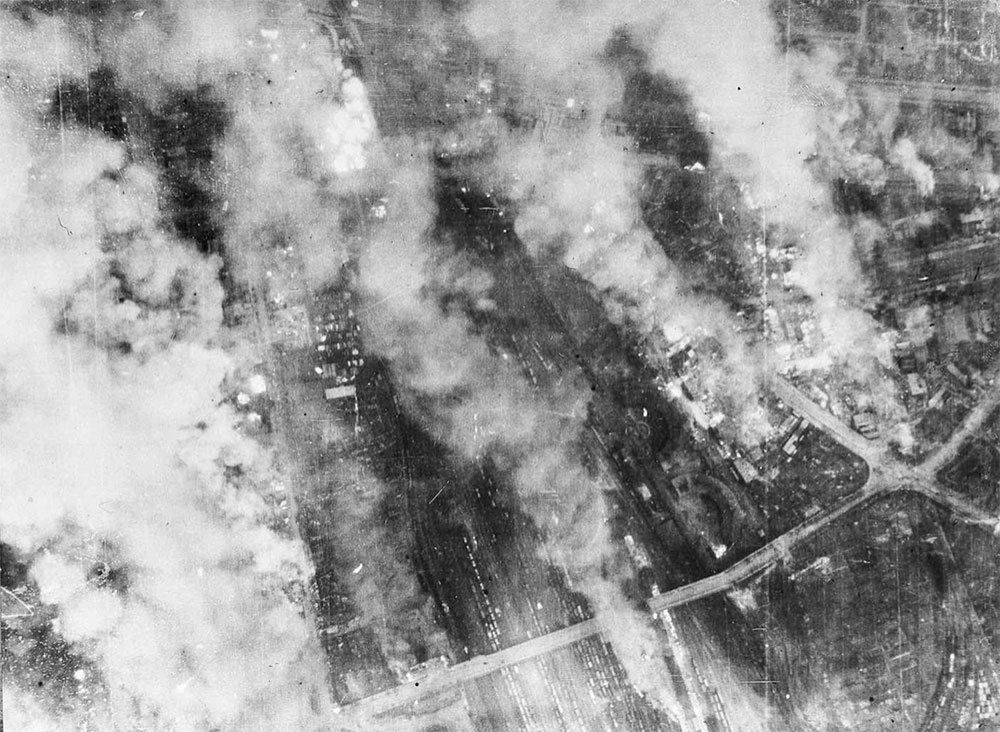
Smoke rises from the fires in Dresden, February 1945
And the wars (too many to list with casualties estimated at 100 million) continued:
World War I – “the War to End All Wars” (July 28, 194 – November 11, 1918) – claimed an estimated 15 to 22 million military and civilian deaths from combat, disease, and war-provoked famine.
World War II (September 1, 1939 - September 2, 1945) claimed an estimated 4% of the global population at the time; 15 million military personnel and 38 million civilians died as a result of war-related factors.
Enter now Robert Schuman (1886-1963).
Born in the Grand Duchy of Luxembourg (squeezed between France and Germany), he was “German” by virtue of “jus sanguinis” (“right of blood”) and assumed French nationality in 1919, after Alsace was retaken by France under the Treaty of Versailles ending World War I. In 1912, he established a law practice in Metz – the city of Pope Leo’s final address during his September pilgrimage to France – and became a member of Parliament in 1918. With the 1939 outbreak of World War II, he was nominated Parliamentary Undersecretary of State for Refugees.
Despite French leader-in-exile Charles de Gaulle’s offer of refuge in London, he refused to cooperate with the Nazi occupiers and his early acts of resistance and formal protests against the Nazi administration resulted in his September 14, 1940 arrest and imprisonment in Metz and, ultimately, transfer to Rhineland-Palatinate. Schuman escaped on August 1, 1942 and, with a 100,000 reichsmark reward on his head, found refuge in monasteries and convents in the French “free zone” while supporting the French Resistance. During the war years, he played a major role in the creation of the Popular Republican Movement, which – after the war – became a major organ of French Christian democracy.
Schuman became the chairman of the Ministry of Finance in the first post-war French government and guided France through a series of communist-inspired labor strikes and unrest, serving as foreign minister in 10 successive governments from July 1948 to December 1952.
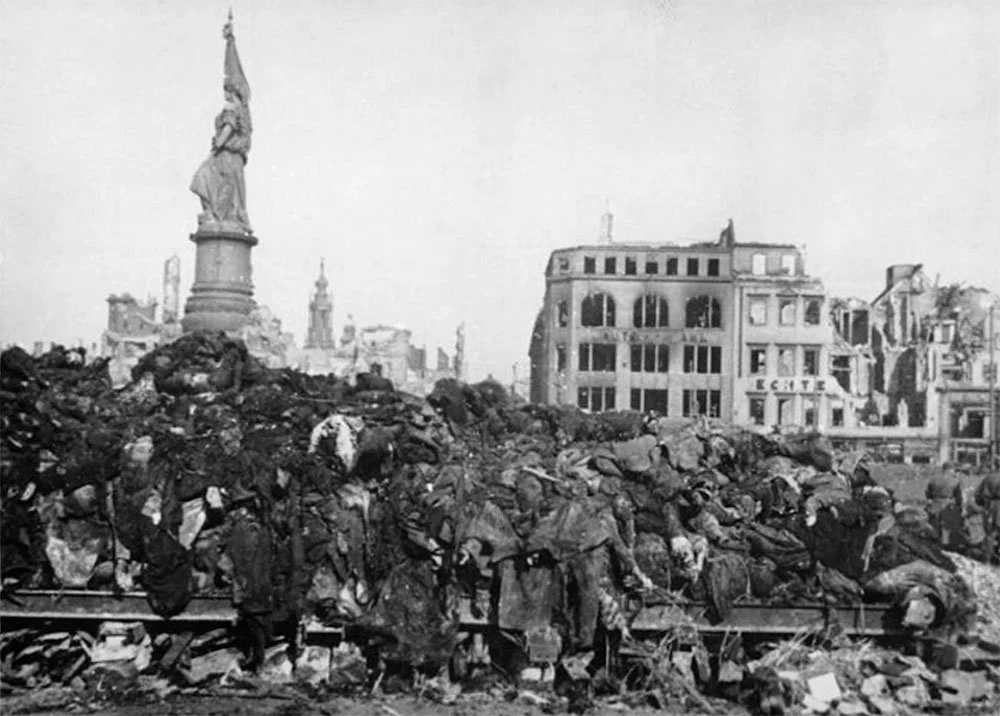
Piles of corpses in front of destroyed buildings in Dresden after air raids
Enter Alcide De Gasperi.
Born (1881) and reared in Trento, then part of the Austro-Hungarian Empire and part of the Kingdom of Italy after World War I, he was a member of the Italian People’s Party. Among the most bitter opponents of the Fascist regimen. he and his wife were arrested by Italian fascists in March 1927 and charged with illegal (“clandestine”) expatriation as they attempted to cross the frontier into Yugoslavia with forged passports. Confined to Rome’s Regina Coeli Prison, his health deteriorated significant during roughly seventeen months in confinement, before the personal intervention of Pope Pius XI resulted in his July 1928 release. For the next fourteen years – until the fall of the Fascist regime, he survived financially with a quiet cataloger’s post in the Vatican Library.
In the post-war years, he served successively as Interim Head of State, President of the Council of Ministers and Prime Minister, Secretary of State, Minister of the Interior, and Minister for Foreign Affairs.
Personal experiences with the excesses of nationalism brought Schuman, de Gasperi and West German Chancellor Konrad Adenauer together with a shared sense of the urgent need to establish a political solution for nationalistic confrontations and avoid future European wars. They understood politics as the highest form of charity and believed that democracy can only be born from a shared sense of fraternity. He understood that Europe needed to put an end to the 2000-year war and came to an agreement with German Chancellor Konrad Adenauer and the French Foreign Minister Robert Schuman and others to lay the foundations of a united and peaceful Europe.
On May 9, 1950, in what became known as the Schuman Declaration, then French Foreign Minister Robert Schuman announced the creation of the European Coal and Steel Community under the control of a common High Authority; the treaty establishing the European Coal and Steel Community was signed in Paris on April 18 by the Federal Republic of Germany, Francie, Italy, Luxembourg and the Netherlands and entered into force on July 23, 1952 – solidifying the first supranational European organization. Establishing a common market for goal and steel, it lay the foundations of an economic community that would gradually become the European Union.
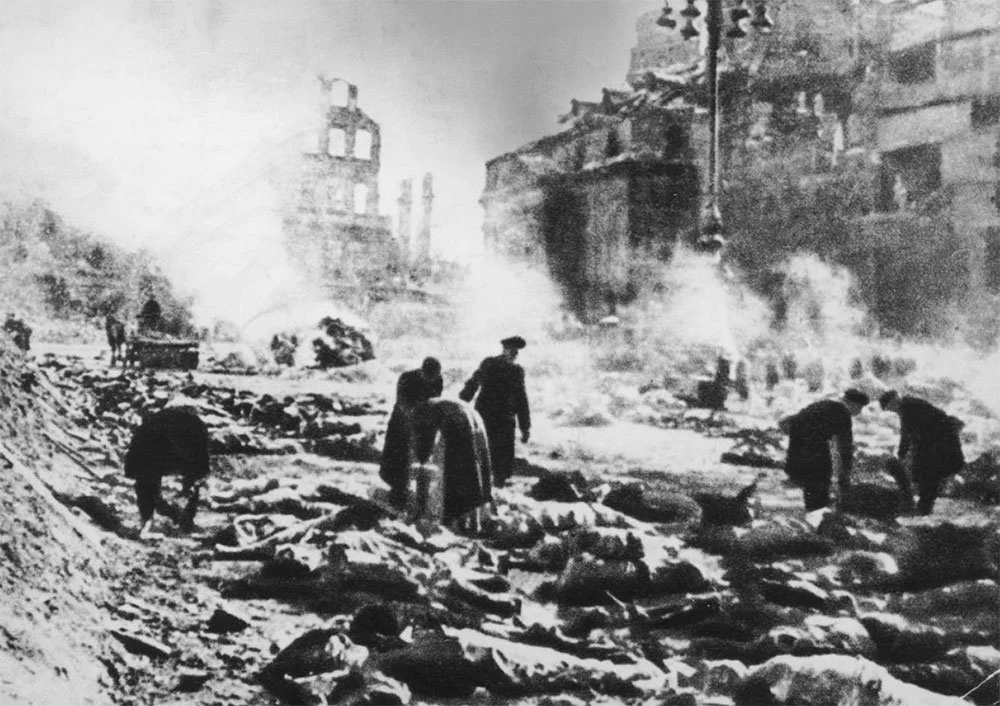
Berlin, February 1940
Fondation Robert Schuman of Le Centre de Recherches et d’etudes sur l’Europe describes not only two men who emerged as quiet leaders after the horrors of the Second World War but the type of leaders the United States needs after November 3 and before the presidential election of November 7, 2028:
“They transformed Europe’s destiny…
“Born of different nationalities, they grew up under the occupation of their regions by their neighbours. As frontiersmen, they constantly sought to overcome those borders.
“Entering politics late in life, they were persecuted by a dictatorial regime and protected by the Catholic Church, whose faith they shared.
“Promoted to the highest responsibilities, they had to solve problems that were far more important than those we face today. The return to the rule of law and the concert of democratic nations, peace in Europe through the construction of Europe, for which Alcide De Gasperi played a decisive role, and of which Robert Schuman was, by his side, the tireless architect.
“But it also involved the signing of key treaties that brought peace after the end of the Second World War: The Council of Europe, the European Community of Steel and Coal, NATO, etc. They were the authors of those treaties, along with others of course, but they were at the forefront.
“These two eminent personalities also shared a common approach to public action. They were humble to the point of austerity, not very fond of grand speeches, but their strong principles, or rather their natural goodness, did not detract from their firmness or their steadfastness over the long term.”
At this mid-October writing, congressional elections are imminent. A fractured Congress remains a possibility and enmity between/among one or both houses of Congress and the presidency is almost certain.
In his March 3, 1865 Second Inaugural Address, Abraham Lincoln cited the warning of Jesus about the personal responsibility of those who cause others to stumble and suffer: 'Woe unto the world because of offenses for it must needs be that offenses come but woe to that man by whom the offense cometh.' (KJV, Matthew 18:7)
Cogently, Lincoln set forth the principle which must guide every member of the 150th Congress:
"With malice toward none with charity for all with firmness in the right as God gives us to see the right let us strive on to finish the work we are in to bind up the nation's wounds, to care for him who shall have borne the battle and for his widow and his orphan ~ to do all which may achieve and cherish a just and lasting peace among ourselves and with all nations."
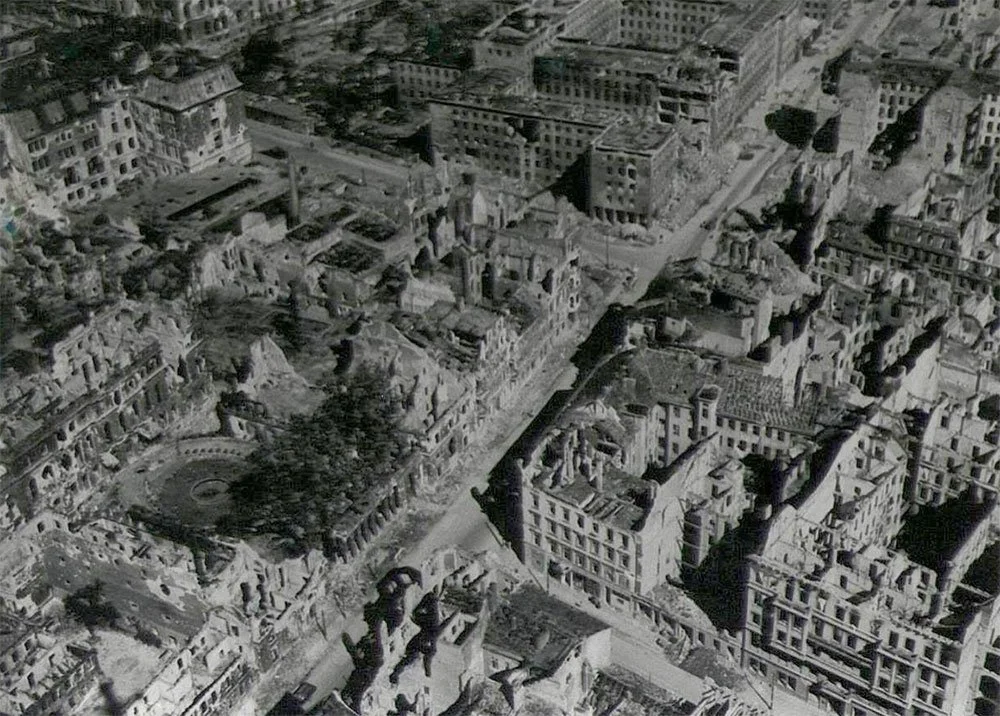
It would take forty years to rebuild bombed-out Berlin
On Wednesday morning November 4, Donald Trump’s will become a lame duck presidency. Office holders who have trembled at the thought of his rebuke or disapproval can free themselves of their Mar-a-Lago slavery and dare to act as public servants while the enslaver of their personal integrity retires to his golf courses.
We pray that the members of the 127th Congress – returning and newly elected, without regard to political party – will take to heart the closing words of Pope Leo’s Metz address:
“… I say: have the courage to take up with responsibility the task of promoting peace — in your hearts, in your relationships, within your families, in schools and universities, in your cities and countries…
Do not give in to the mentality of violence and oppression.
Love life at every moment, and do not be afraid of the future!
Do not be afraid to start a family, to bring children into the world, to defend the dignity of every person, from the moment of conception to death.
Do not be afraid to work tirelessly for the good of your communities, including through political engagement.
Be builders of community!...
May God sustain you in these commitments.