
MR. PRESIDENT: “HIC IACET PVLVIS CINIS ET NIHIL”
Vanity of vanities, says the Preacher,
vanity of vanities!
All is vanity.
For everything there is a season,
and a time for every matter under heaven:
a time to be born, and a time to die;
…All go to one place;
all are from the dust,
and all turn to dust again.
Ecclesiastes
Donald J. Trump, President
The White House
1600 Pennsylvania Avenue
Washington, District of Columbia
Mr. President:
You will die.
That, Sir, is not a threat.
Please don’t use our words as another money-grabbing fake threat against you.
Understand them for what they are: A statement of fact.
In 2018, the English edition of Un temps pour mouir: derniers jours de la vie des moines: recit – A Time to Die: Monks on the Threshold of Eternal Life – made its appearance. Author Nicolas Diat visited eight European Benedictine and Trappist monasteries and recounts the deaths of monks whose ages spanned from their late twenties to days short of a century.
The famous Trappist (Cistercians of the Strict Observance) Abbey of Cîteaux dates to March 21, 1098. That’s a simple way of telling you that they have more than 900 years of figuring out Life, Faith, Christianity and Death.
Just for perspective: Based on the Rule of St. Benedict (written around 530 AD), Cîteaux was founded more than a century before St. Francis of Assisi established his communities of Little Brothers. Diat explains the Trappist response to death very directly: “The rule of the monks of Citeaux is simple: one has to die someday.”
Mr. President, you will die…
As we write this…
In office…
Years from now…
Someday…
“All empty souls tend toward extreme opinions.”
William Butler Yeats
“I have never seen anything more striking.”
Donatien Alphonse François, Marquis de Sade (1775)
You are, Sir, almost certainly not familiar with Thérѐse of Lisieux, one of the best-selling authors of all time. In 1888, at age 15 (and with special permission of Pope Leo XIII, because she was so young), she followed two of her older sisters and joined the cloistered Carmelite convent of Lisieux in Normandy. After nine years and having dedicated herself to what she called her “little way” – a hidden path of radical love, self-sacrifice and humility, she died of tuberculosis on September 30, 1897. She was 24 years old.
Approaching her death and at the direction of the Prioress of the convent, Thérèse began to writer her memoirs. Her autobiography L’histoire d’une Âme (Story of a Soul) became an instant spiritual classic and has sold more than 500 million copies (while your Art of the Deal may have hit 1.7 million). [We just could not help ourselves with that comparison.]
In part because of Story but primarily because of her virtuous life and the miracles attributed to her after her death, Thérèse was declared a saint in 1925 and one of only 38 Doctors of the Church – the highest honor for theologians and spiritual writers in the 2,000-plus years history of Roman Catholicism – in 1997.
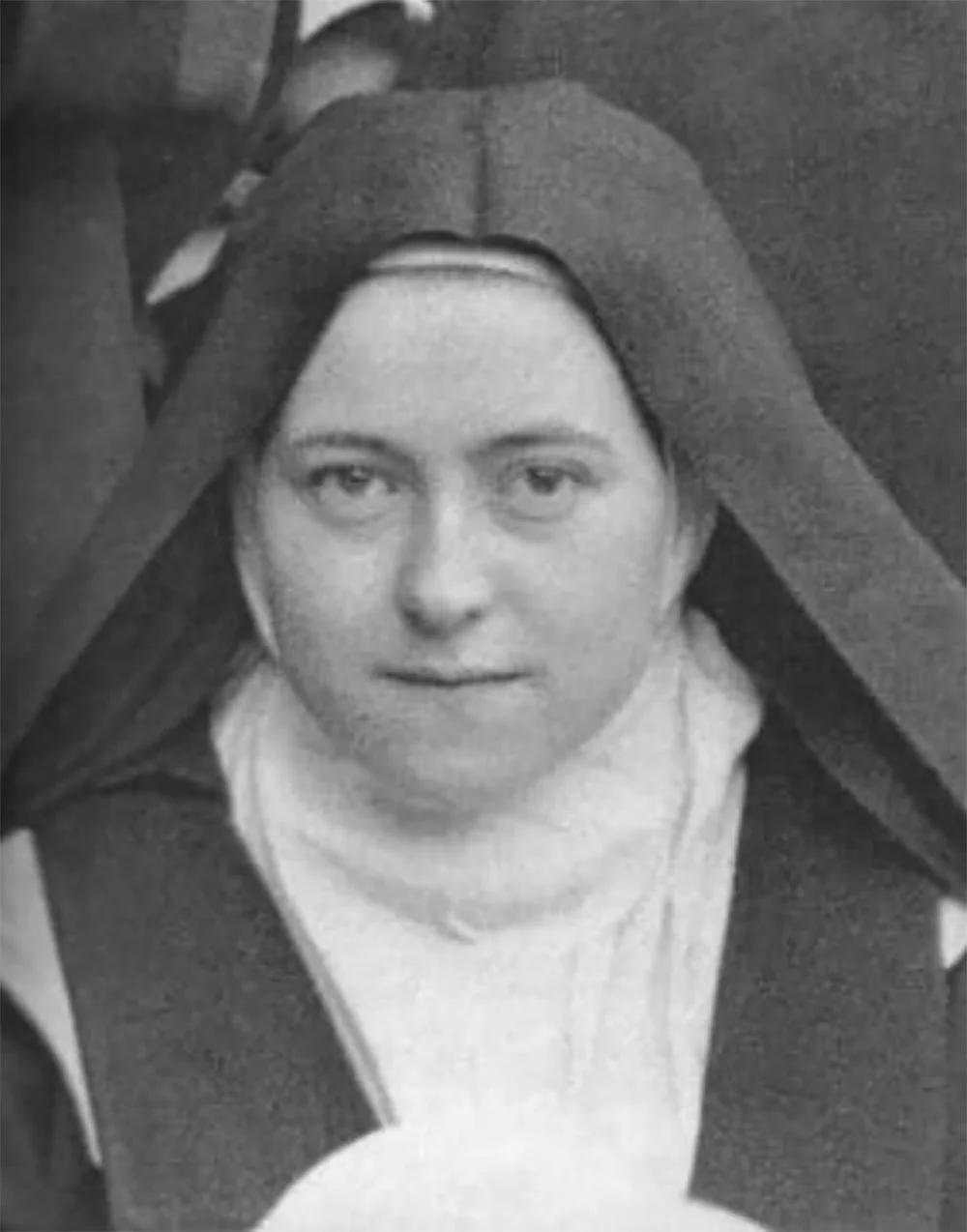
St. Thérѐse of Lisieux
Thérèse has two lessons for you, Mr. President:
“Miss no single opportunity of making some small sacrifice, here by a smiling look, there by a kindly word; always doing the smallest right and doing it all for love.”
“I am not dying; I am entering into life.”
Ossuaries have much to teach you, Mr. President.
In case the words – “ossuary” and “ossuaries” - are not part of your vocabulary, we’ll explain: Ossuaries are secondary burial sites; “secondary” because, after original burials, when the flesh and soft parts of bodies have decomposed, the skeletal remains are collected and stored in common chambers; when cemeteries became overcrowded and burial spaces scare, they often house the remains of thousands of men, women and children.
In fact, the Indian Neck Ossuary in Wellfleet, Massachusetts is one of the most significant Native American archaeological discoveries in the present-day United States and dates back approximately 1,100 years to a time when the site was home of the Punonakanits, a Wampanoag group who lived and fished there for centuries.
Now under the supervision of the National Park Service and the Cape Cod National Seashore, the Little Neck Ossuary was discovered by accident. In September 1979, a backhoe operator digging a hole for a cottage’s septic tank unearthed human remains and, within two weeks and after the cottage owners gave permission, archaeologists from the Park Service began excavating the remains of at least 56 men, women and children interred together. It is one of the best-documented North American ossuaries outside northwestern New York State, adjacent parts of Ontario, and the area around the Potomac River and Chesapeake Bay.
But, if you’ll pardon the expression, fifty-six remains is nothin’!
The Sedlec Ossuary – “the Bone Church” - in Kutna Hora, Czechia contains between 40,000 and 70,000 skeletons, including a splendid bone chandelier composed of almost every bone in a human body, two large bone chalices, six enormous bone pyramids, and skull candle holders.
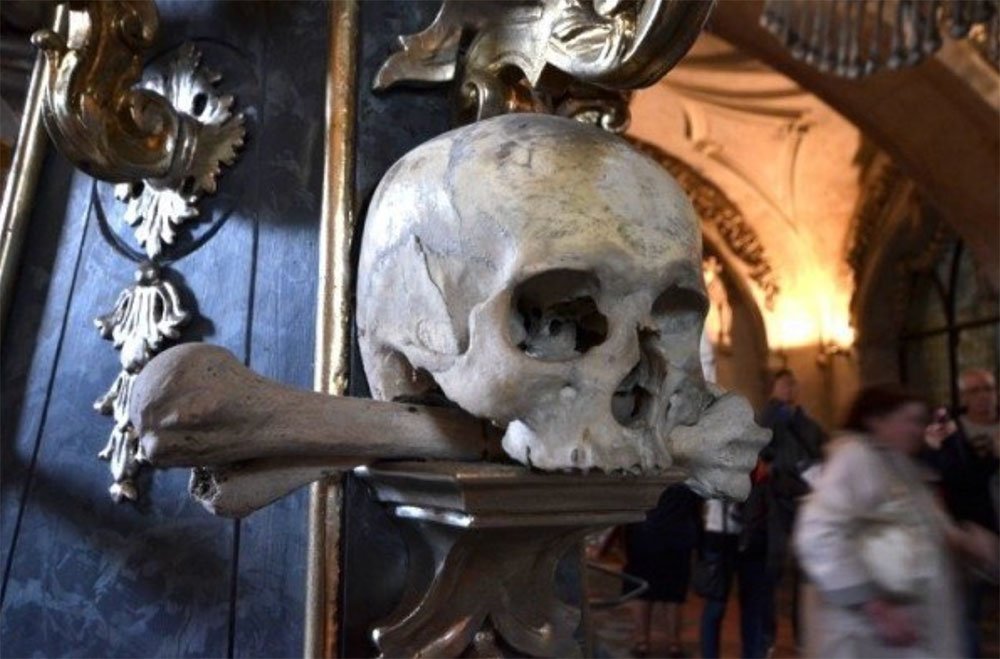
The Sedlec Church
In the 1700s, the Hallstatt Catholic Church began digging up corpses to make way for the newly dead. Once skeletons were exhumed and properly bleached in the sun, family members would stack the bones next to their nearest kin. In the 1720, folks began a tradition of painting the skulls with symbolic decorations, as well as dates of birth and death so that dead would be remembered, even if they no longer had a grave. Of the 1,200 skulls preserved in the ossuary, approximately 610 are lovingly decorated with laurels for valor, roses for love, and other remembrances.
The catacombs of Lima, Peru’s Monastery of San Francisco, founded in 1564, were originally designed for burial, especially for those who could not afford a traditional funeral. As a result and over two centuries, the catacombs became the final resting place for an estimated 70,000 people whose skulls and bones were (sometimes) decoratively arranged in the tunnels beneath the monastery.
If you visit the San Francisco catacombs, keep your eyes peeled (and maybe carry some holy water – for “just in case”) because one of the most fascinating myths about the San Francisco ossuary is that of the ghost of an elderly monk who appears in the catacombs late at night. Visitors and staff often see him wandering the passageways and legend has it that his apparitions result from the many souls lost during the cruel colonial era, with some still haunting the catacombs.
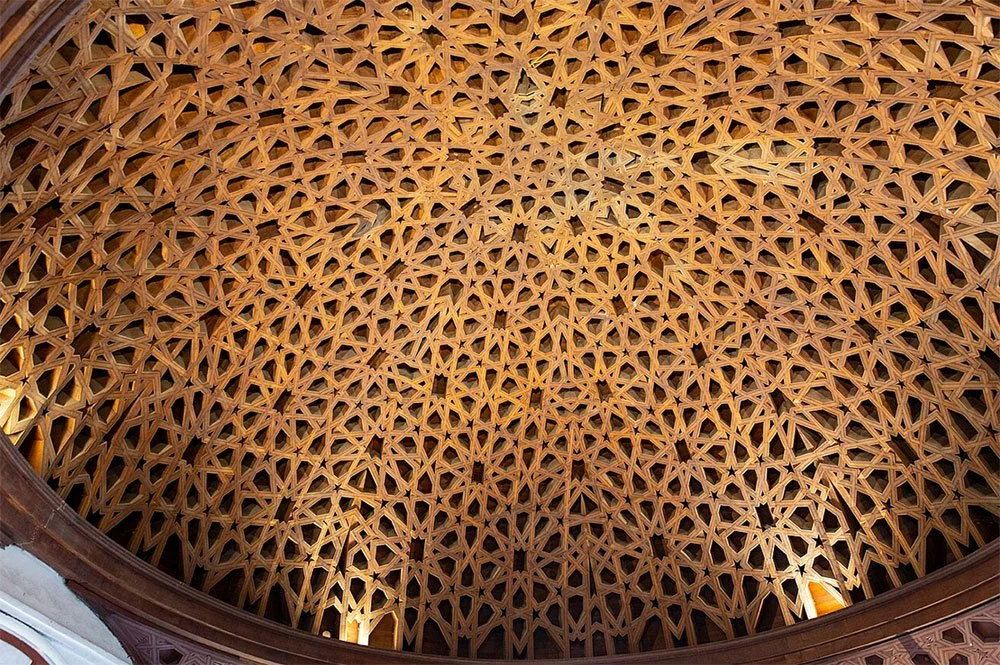
Mudejar Dome of San Francisco, Lima, Peru
Mr. President, the next time you’re in Rome, be sure to visit Santa Maria della Concezione. Close to the Trevi Fountain, it was completed in 1634 and has received some unique reviews: In 1775, the (in)famous Marquis de Sade wrote of it “I have never seen anything more striking.”
When the Capuchin monks moved from their old friary of St. Bonaventure, they were ordered by Cardinal Antonio Barberini (the Pope’s brother and a Capuchin) to bring their dead brothers – 300 cartloads of decaying bodies and bones of deceased monks - with them so that all the friars might be together in one place. The cardinal died in 1646 and he is entombed directly in front of the main altar. Mr. President, spend some time meditating on the Cardinal’s tomb slab. It reads “HIC IACET PVLVIS CINIS ET NIHIL” – “Here lies dust ashes and nothing.”
But we’re really anxious for you to visit the crypt on the lower level. When the monks moved from St. Bonaventure’s to Concezione, rather than simply rebury the remains of their dead brethren, they decorated the walls of the crypts with their bones – a way of reminding the living that death can come at any time. The ossuary contains separate crypts of leg bones, skulls, and pelvises; mummified monks are dressed in friar’s clothes and hang from walls and ceilings.
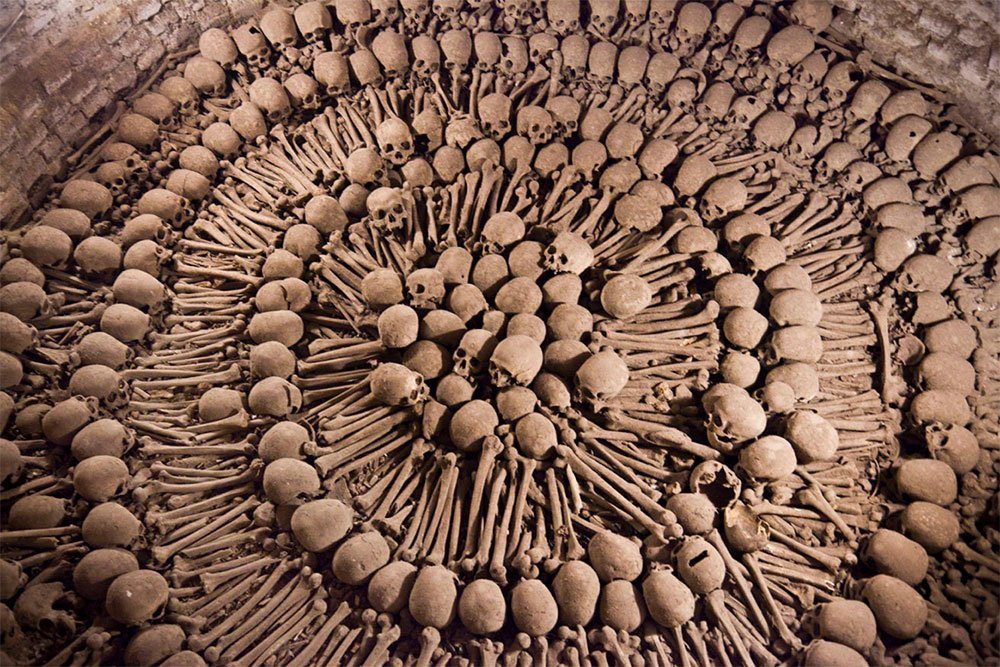
A segment of the ossuary of San Francisco
In his 1869 book Innocents Abroad, American author Mark Twain recalls visiting Concezione and asking a monk what would happen when he died. “We must all lie here at last,” replied the friar.
Every lasting portion of the human frame was represented in
these intricate designs (they were by Michael Angelo, I think,) and there
was a careful finish about the work, and an attention to details that
betrayed the artist's love of his labors as well as his schooled ability.
I asked the good-natured monk who accompanied us, who did this? And he
said, "We did it"--meaning himself and his brethren up stairs. I could
see that the old friar took a high pride in his curious show. We made
him talkative by exhibiting an interest we never betrayed to guides.
"Who were these people?"
"We - up stairs - Monks of the Capuchin order - my brethren."
"How many departed monks were required to upholster these six parlors?"
"These are the bones of four thousand."
"It took a long time to get enough?"
"Many, many centuries."
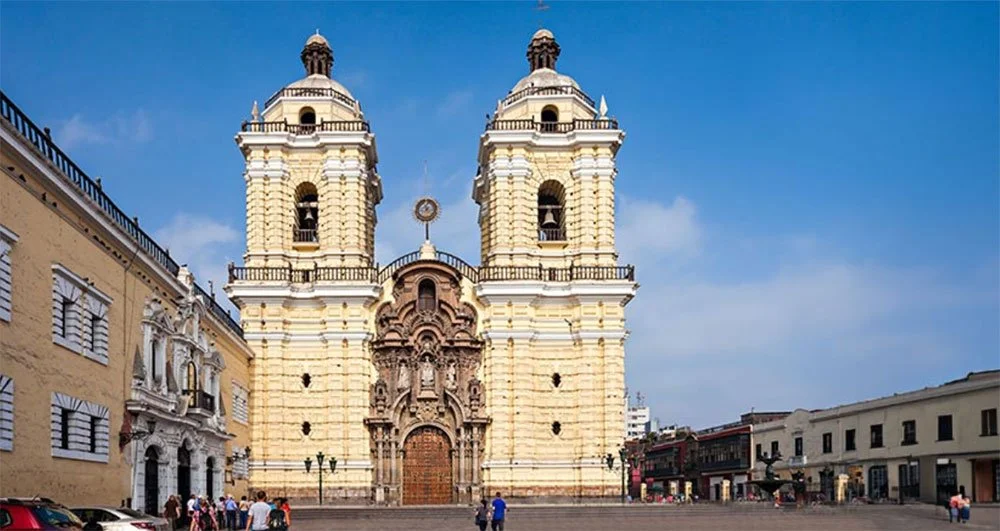
Convento de San Francisco, Lima
"Their different parts are well separated - skulls in one room, legs in
another, ribs in another - there would be stirring times here for a while
if the last trump should blow. Some of the brethren might get hold of
the wrong leg, in the confusion, and the wrong skull, and find themselves
limping, and looking through eyes that were wider apart or closer
together than they were used to. You can not tell any of these parties
apart, I suppose?"
"Oh, yes, I know many of them."
He put his finger on a skull. "This was Brother Anselmo--dead three
hundred years - a good man."
He touched another. "This was Brother Alexander - dead two hundred and
eighty years. This was Brother Carlo - dead about as long."…
I asked the monk if all the brethren up stairs expected to be put in this
place when they died. He answered quietly: "We must all lie here at last."
[Francis of Assisi founded the “Little Brothers” – Friars Minor – in 1209; the break-away Capuchins were officially established in 1528 by Matteo da Bascio (1485-1552), seeking to return to the strict, original lifestyle and spirit of poverty of St. Francis. Established during the period of the Lutheran Reformation, their name derives from the hood – in Latin cappa - worn by members of the order.]
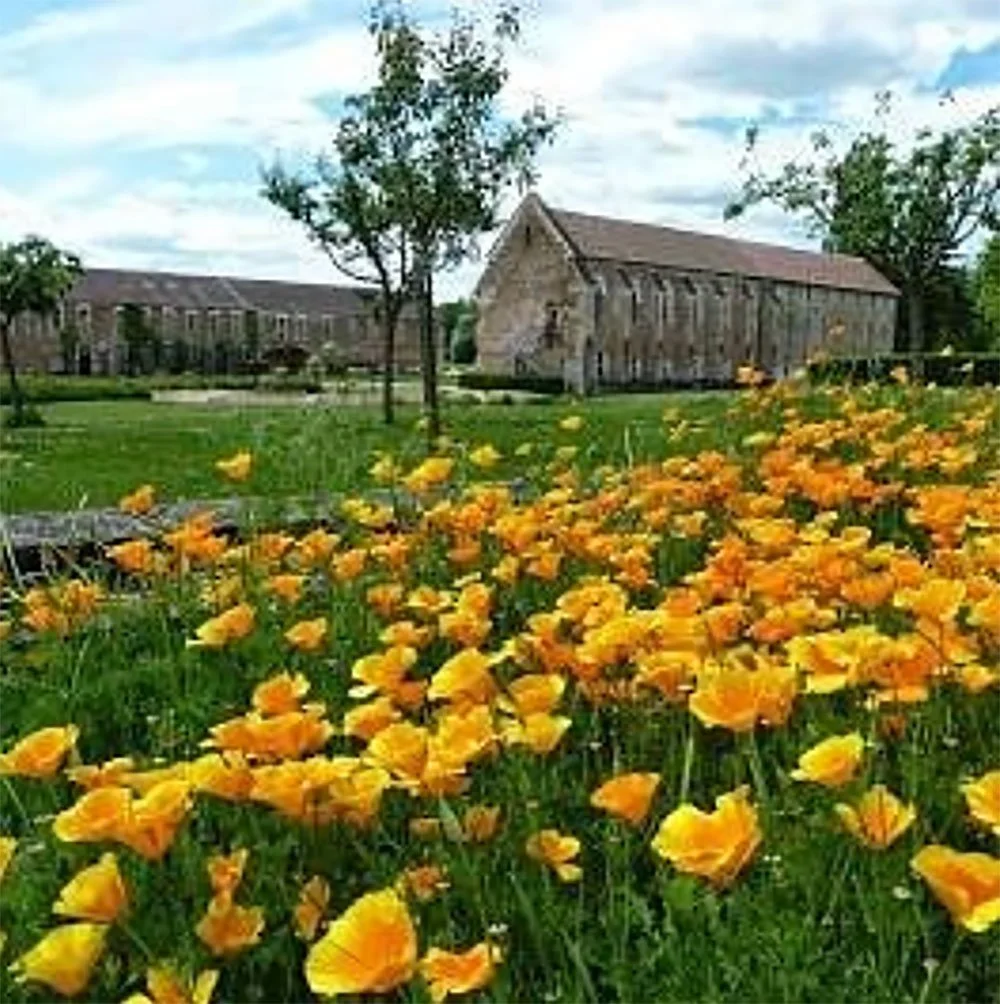
The Cîteaux Monastery
And, Mr. President, while at Santa Maria della Concezione dei Cappuccini, please take special note of the plaque in one of the chapels. Written in three languages, it is the admonition of six-hundred years and more than 4,000 Capuchin friars: “What you are now, we once were; what we are now, you shall be.”
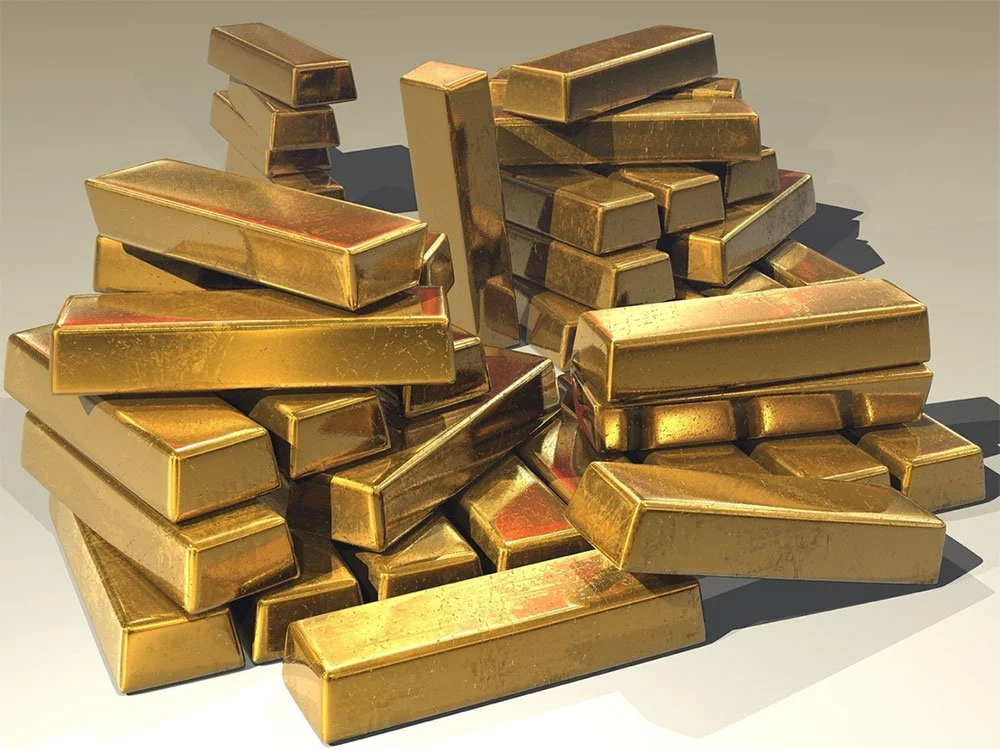
Mr. President, with your notorious, almost sordid desideratum for plastering your name wherever possible and for all-things-gold and while there’s still time, learn the lesson of the world’s ossuaries: They are goldless and, in the end, you – we – will come to dust.
In the 5th Century BCE, the authors of Genesis (3:19) anticipated you, Mr. President, when they cautioned “Dust you are and to dust you will return.” Democritus, Plato, Socrates, Seneca, Marcus Aurelius… In one language or another, they all taught “Memento mori – Remember that you have to die.” And not one taught that you could take the gold or one of your eponymous coins with you.
More than half-a-century ago at the Maryknoll Seminary in Ossining, New York, Father William Frazier taught that – and we are summarizing – plastering your name wherever possible, building arches and towering monuments to oneself, the avaricious accumulation of conspicuous wealth, the constant belittling of others in order to enhance one’s sordid sense of self, all in a desperate and futile attempt to ward off death is the underlying fount of sin and the ultimate expression of a one’s fear of death.
It is not death that breeds sin and evil. It is the fear of death….
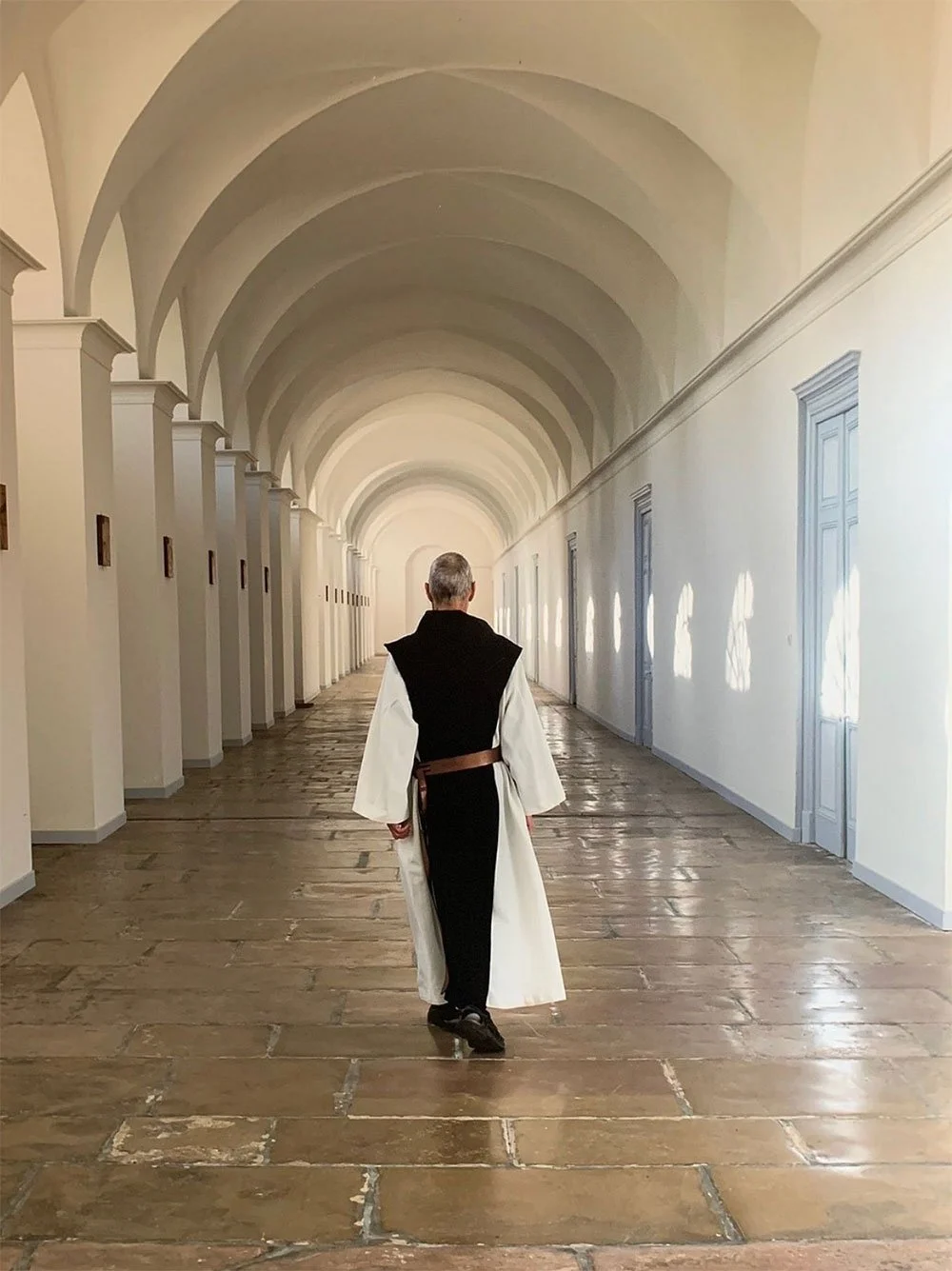
The Cîteaux Monastery
Mr. President, you will die and you will never take a penny of your money or a brick of your arches or your gold trim or golden trophies with you.
As priests, we offer you the observation Brother Philippe, the long-term infirmarian at Citeaux, shared with Diat:
“Thinking about death is not morbid. On the contrary, it enables us to understand the meaning of life. It is necessary to learn to recognize the end of our road. Why be afraid? The Resurrection is the foundation of our faith. Real life is not on earth. Every day, we must prepare to die.”
MEMENTO MORI!
Rev. Francis J. (Skip) Flynn, M.Div., Psy.D.
Rev. Roger Tobin, M.Div., M.S.
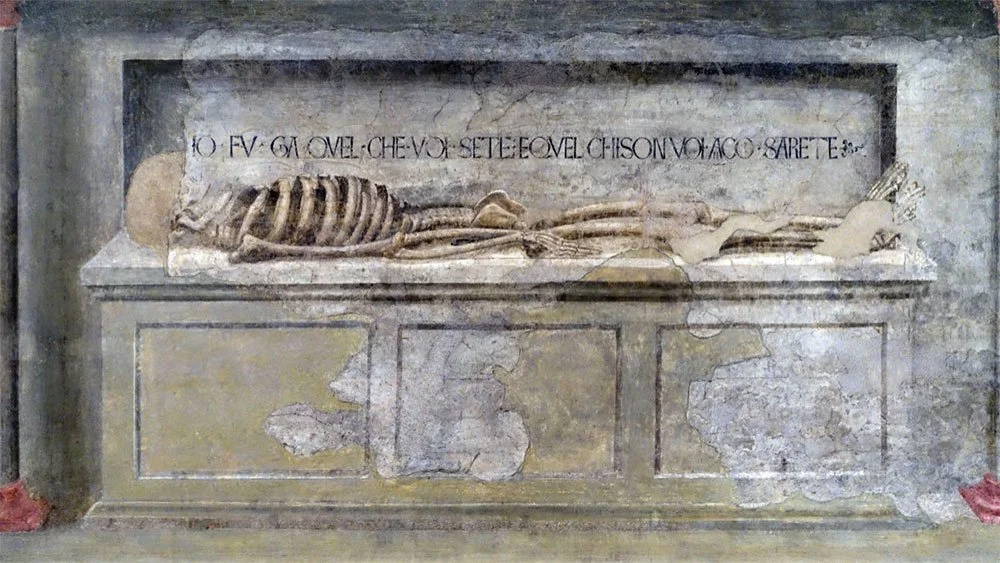
TOPMOST ILLUSTRATION: The lower portion of a 1425-1426 fresco of the Holy Trinity (1425-1426) by Tommaso Guido, known as Masaccio, in the Basilica Santa Maria Novella (Florence). The entire fresco was covered by another image in 1570 and rediscovered in good condition during an 18th century restoration. The above image went undiscovered until another restoration in 1952. The ghoulish skeleton gives emphasis to the words “What you are, I once was; what I am, you will become.”